


Last Updated: November 4, 2026
Quick Summary
Check the hallmarks and maker's marks, the metal content, the clasp, the settings and any repairs before buying vintage jewelry. Magnify every stamp and confirm it matches the seller's description, since a stamp is a claim rather than proof. Then inspect the clasp and stones, and ask the seller to state any repairs in writing.
- Vintage jewelry is generally at least 20 years old, while antique jewelry is typically 100 years or older.
- Examine every stamp under a 10x jeweler's loupe, because many look smooth to the naked eye.
- A stamp reading 14K GP or 14K RGP means gold plated, not solid gold.
- Open and close the clasp several times, since a weak clasp is the most common reason pieces are lost.
- Ask the seller directly whether the piece has been repaired, and get the answer in writing.
Table of Contents
- Vintage vs. Antique: Knowing What You Are Actually Buying
- How to Identify Vintage Jewelry Hallmarks and Maker's Marks
- Evaluating Metal and Gemstone Quality
- Inspecting Condition: Clasps, Settings, and Damage
- How to Spot Fake Vintage Jewelry and Reproductions
- Best Places to Buy Vintage Jewelry Online
- Your Next Step: Choosing a Piece You Can Gift With Confidence
- Frequently Asked Questions
Vintage vs. Antique: Knowing What You Are Actually Buying
Vintage jewelry is generally considered to be pieces at least 20 years old, while antique jewelry is typically 100 years or older. That distinction matters when you're shopping, because sellers sometimes use the words loosely. Knowing the difference helps you judge what you're actually paying for.
Vintage pieces often reflect a specific era's design language, such as Art Deco or mid-century modern. Antiques carry more age and rarity, which can raise prices but also raises the bar for authenticity checks. Neither is automatically better for a gift. Ask the seller directly when a piece was made and what evidence supports that date.
How to Identify Vintage Jewelry Hallmarks and Maker's Marks
Hallmarks and maker's marks are the first clues to a piece's metal content and origin, but they are also the most frequently misread. A stamp tells you what a maker claimed, not what a piece is. Treat every mark as one data point among several.
What the common stamps mean. On silver, look for "925" or "STERLING"; on gold, karat markings like "14K" or "585" (the millesimal equivalent). Platinum is often marked "PLAT" or "950." Costume pieces may carry a maker's name or a country-of-origin stamp with no precious-metal content at all. A stamp that reads "14K GP" or "14K RGP" means gold plated or rolled gold plate, not solid gold, and that distinction changes value by an order of magnitude.
Where to look. Stamps hide on the clasp, inside a ring band, on the back of a pendant, on the bail, or along the edge of a brooch. Some pieces carry marks on a small tag near the clasp that is easy to miss. Examine the piece under a 10x jeweler's loupe; many stamps that look smooth to the naked eye resolve into readable characters at magnification.
How to check a hallmark in practice:
- Locate every stamp on the piece, not just the first one you find. Multiple marks (metal content plus maker plus country) are more convincing than a single mark.
- Magnify each mark and confirm the metal content matches the seller's description.
- Compare the maker's mark against a reference source. The Online Encyclopedia of Silver Marks, Hallmarks & Makers' Marks is a commonly used free reference for silver; for gold, manufacturer and assay-office references vary by country and era.
- Cross-check the mark against the piece's weight, wear pattern, and construction method. A stamp that says "sterling" on a piece that feels unusually light for its size deserves scrutiny.
- Note any mismatch and ask the seller to explain it in writing before you pay.
Era-specific stamping conventions.
The limits of hallmarks. A hallmark can be added, altered, or faked. Marks that look too crisp, too uniform, or sit on a surface with no surrounding wear are worth questioning. A common pattern is a genuine-looking stamp on a piece whose construction details (machine-perfect settings, modern findings) don't match the era claimed. Pair the stamp with other evidence before trusting it.
Online Encyclopedia of Silver Marks, Hallmarks & Makers' Marks
Evaluating Metal and Gemstone Quality
Metal quality determines durability and value. Solid gold and sterling silver hold up far better over decades than gold-filled or vermeil, which are thin layers over base metal. For a broader guide to judging jewelry quality overall, see how to tell if jewelry is high quality. Gold vermeil can look appealing, but its plating wears through with regular contact. To understand how it differs from solid gold, read gold vermeil vs solid gold. If longevity matters for a gift, check whether the piece is solid metal or plated.
Gemstones need the same scrutiny. Check whether a stone is genuine, synthetic, or glass by looking for natural inclusions and consistent facet edges under magnification. Cabochons and facets should look intentional, not chipped. Ask whether the stones are original to the piece or replacements, because replacement stones can affect value.
Inspecting Condition: Clasps, Settings, and Damage
Condition affects both wearability and resale value, and the order in which you inspect matters. Work from the part most likely to fail toward the part least likely to fail, so you don't miss a structural problem while admiring a stone.
1. The clasp. A weak or bent clasp is the most common reason vintage pieces are lost. Open and close it several times. A safety catch should snap firmly and stay closed under light pull. On box clasps, check that the tongue seats fully; on lobster claws, check that the spring returns. A clasp that opens under gentle tension is a repair waiting to happen.
2. The chain or shank. Test every link on a chain by running it through your fingers and looking for stretching, thinning, or solder joints that don't match the rest of the chain. On rings, check the shank for thinning at the bottom, where wear concentrates, and for a sizing seam that suggests the ring was altered.
3. The settings. Check every stone for loose prongs by gently pressing the stone with a soft tool or your fingernail; movement means a prong is worn. Look for cracked bezels, missing accent stones, and glue residue around a stone, which often signals a past replacement. On older pieces, prongs are frequently worn thin at the tips and need retipping, a routine repair that a jeweler can quote before you buy. If a chain is already broken, see how to repair broken personalized jewelry chains.
4. Surface and patina. Patina is natural surface oxidation that can be acceptable, even desirable, on vintage silver. Heavy tarnish, corrosion, or active verdigris (green residue) is different and may indicate base-metal content under plating or long-term moisture exposure. Distinguish between a piece that needs cleaning and a piece that has been damaged.
5. Repairs and alterations. Repairs are not always a dealbreaker, but you should know about them before buying. A replaced stone, a re-shanked ring, or a re-soldered clasp changes both value and the piece's originality. Ask the seller directly whether the piece has been repaired, and get the answer in writing.
Preservation after purchase. Most guides stop at inspection, but how you store a vintage piece determines whether it survives the next decade. Store silver in tarnish-resistant bags or a lined box with a tarnish-inhibiting strip, and keep pieces separated so stones don't scratch each other. You can also learn how to care for personalized sterling silver jewelry. Remove jewelry before swimming, showering, or applying lotion, since chlorine and cosmetics attack plating and accelerate oxidation. Have prongs checked by a jeweler once a year if you wear the piece regularly; a loose prong is cheap to tighten and expensive to replace a stone for. For pieces you rarely wear, store them flat with clasps closed to prevent chain kinking.
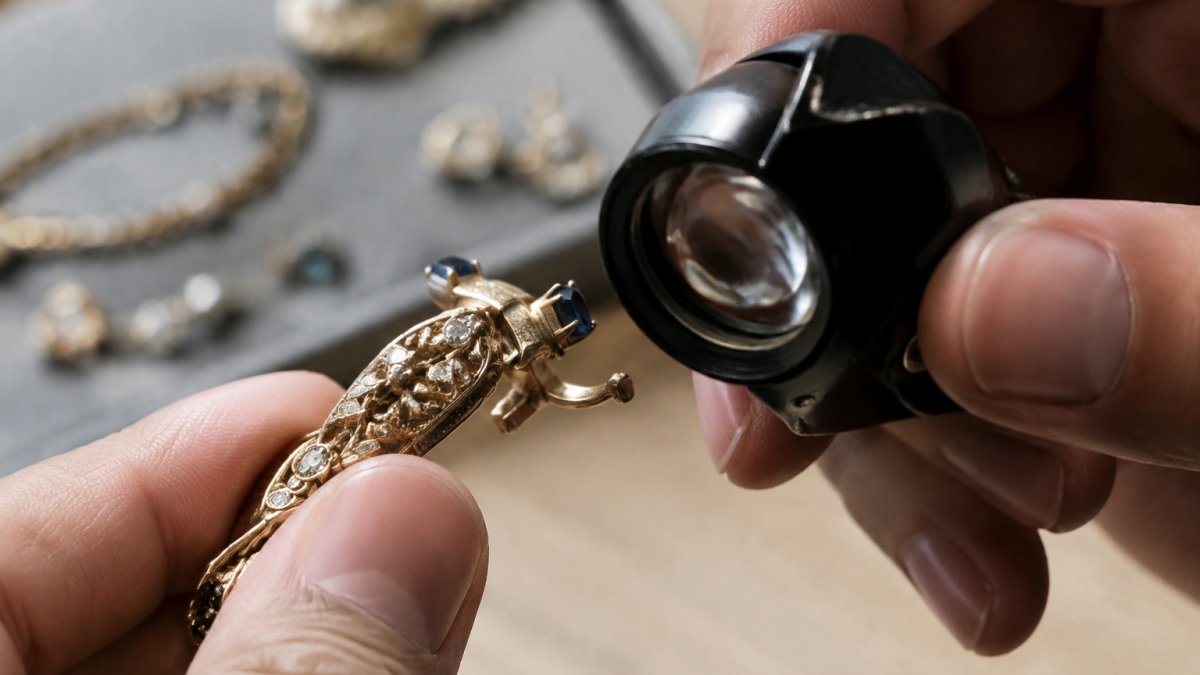
Work through these checks in order, starting with the parts most likely to fail.
| Check | What to look for | Why it matters |
|---|---|---|
| Clasp | Snaps firmly and stays closed under light pull | Weak clasps are the most common reason pieces are lost |
| Chain or shank | Stretching, thinning, or mismatched solder joints | Shows wear or past alteration |
| Settings | Loose prongs, cracked bezels, glue residue | Signals worn prongs or a past stone replacement |
| Surface and patina | Natural patina versus heavy tarnish or verdigris | Heavy corrosion can mean base metal or moisture damage |
| Repairs | Replaced stones, re-shanked rings, re-soldered clasps | Changes both value and originality |
How to Spot Fake Vintage Jewelry and Reproductions
Reproductions are common, and many are made to look old on purpose. Watch for stamps that appear shallow or inconsistent, unusually light weight for the stated metal, and design details that don't match the era being claimed. A piece marked as Victorian that uses modern findings or a machine-perfect finish deserves a closer look.
A simple magnet test can help. Gold and silver are not magnetic, so a strong pull suggests steel or another base metal. This test doesn't prove authenticity on its own, but it can quickly rule out obvious fakes.
Best Places to Buy Vintage Jewelry Online
Online marketplaces range from curated estate jewelers to open listing platforms, and seller reputation matters more than the platform name. Look for sellers who provide close-up photographs of stamps, clasps, and stones, and who describe any repairs or replacements in writing. Return policies are important for jewelry you can't inspect in person.
Be wary of listings that use vague terms like "antique style" or "vintage-inspired" when they should state the era and materials plainly. Ask for a certificate or appraisal when the price is significant, and confirm the seller's return window before you pay.
Your Next Step: Choosing a Piece You Can Gift With Confidence
Before you buy, confirm the metal content, check the clasp and stones, and make sure the seller will stand behind the piece. For guidance on picking durable personalized jewelry that will last, start there. If you are considering a personalized piece, you can browse Gear Luxe Co's website for current options, pricing, and delivery details. Shop Now at Gear Luxe Co.
Frequently Asked Questions
How can you tell if vintage jewelry is authentic?
Start with the hallmarks. Look for maker's marks and metal stamps such as 925 for sterling silver or 14K for gold, using a 10x jeweler's loupe. Next, check the weight and feel of the piece, since solid metal feels heavier than plated or hollow pieces. Test magnetism, because most silver and gold pieces are not magnetic. Finally, examine the construction: genuine older pieces often show hand-finished details, while mass-produced reproductions tend to have uniform, machine-perfect edges. No single test is conclusive, so combine several checks before paying a premium price.
What are the key differences between vintage and antique jewelry?
Vintage jewelry is generally considered to be at least 20 years old, while antique jewelry is typically 100 years old or more. Many collectors use the 100-year mark as the dividing line for antiques. Vintage pieces often reflect styles from specific eras, such as Art Deco or mid-century modern designs. Antiques carry more historical rarity but can also require more careful handling and preservation. Knowing which category a seller means helps you set realistic expectations for age, value, and condition.
How do I determine the value of a vintage jewelry piece?
Value depends on metal content, gemstone quality, maker, era, condition, and current demand. Check the metal stamp and weight first, then look at stone quality and setting. Compare recent sold listings for similar pieces rather than asking prices, which often run high. For valuable or heirloom pieces, a written appraisal from a certified gemologist or accredited appraiser gives you documentation for insurance purposes. Ask whether the seller can provide provenance or prior appraisal records.
Is it worth buying vintage jewelry?
Vintage jewelry can be worth buying when you want unique, non-mass-produced pieces with character and craftsmanship that is hard to find new. Pieces made from solid metals and well-set stones often hold value better than costume jewelry. However, condition matters greatly: repairs, worn plating, and missing stones reduce both wearability and resale value. Buy from sellers who describe condition honestly and offer a return window, especially when the piece is a gift.


