


Last Updated: October 30, 2026
Quick Summary
Most broken personalized jewelry chains are fixable by matching the repair to the break: reconnect snapped ends with a jump ring, close an open link with chain-nose pliers, or swap a worn clasp. Solid gold, silver, snake, and herringbone chains need a jeweler's solder, while stainless steel tolerates home jump-ring repairs.
- Diagnose first: clasp, chain link, end fitting, or nameplate damage each needs a different fix.
- Four basic tools cover most home repairs: chain-nose pliers, cutters, jump rings, and a soft cloth.
- Never grip or bend the nameplate; work only on the chain and its connectors.
- Open jump rings with a twisting motion, never a sideways pull, and close them with no gap.
- Snake and herringbone chains are soldered tube construction and need professional repair only.
Table of Contents
- How to Repair Broken Personalized Jewelry Chains: Start With the Break
- Tools You Need for a Basic Chain Repair
- How to Fix a Broken Name Necklace Without Damaging the Nameplate
- Jewelry Jump Ring Repair: Reconnecting Chain Ends Safely
- How to Fix a Broken Box Chain and Other Chain Styles
- Necklace Chain Repair Cost and When to See a Jeweler
- Choosing a Replacement Personalized Necklace From Gear Luxe Co
- Frequently Asked Questions
How to Repair Broken Personalized Jewelry Chains: Start With the Break
A broken personalized jewelry chain rarely fails at random. It snaps where the metal is thinnest, where it bends most, or where a clasp has worn down over years of daily wear. At Gear Luxe Co, we hear from customers who panic the moment a name necklace breaks, and the good news is that most breaks are fixable. This guide walks you through how to repair broken personalized jewelry chains step by step, from the first inspection to the final polish, so you can decide what to fix at home and what deserves a jeweler's bench.
Before you touch anything, look closely at the break.
Check the Clasp, the Chain, and the Pendant
The first step is diagnosis, not repair. Where the chain failed tells you how to fix it.
- Clasp break: The lobster claw or spring ring won't close, or the loop it hooks into has opened. This is a common and easy fix.
- Chain link break: A single link has snapped or stretched open. Look for a gap in the pattern.
- End fitting break: The chain has pulled free from the clasp's jump ring or end cap.
Set the piece on a soft cloth under bright light. For guidance on handling the piece safely while you inspect it, see How to Care for Personalized Sterling Silver Jewelry. A white cloth helps you spot small jump rings that roll away. Never work over a sink or carpet, because dropped parts vanish fast.
Tools You Need for a Basic Chain Repair
You need four tools for most home repairs, and none of them cost much. A pair of chain-nose pliers, a pair of cutters, a pack of jump rings, and a soft cloth cover the majority of fixes. Chain-nose pliers have flat, tapering jaws that grip small links without crushing them. Cutters snip through damaged links cleanly. Jump rings reconnect broken ends.
A few extras help:
- A magnifying glass or a phone camera zoom to see small gaps
- A plastic tray or dish to hold loose parts
- A polishing cloth to finish the piece afterward
Skip the household tweezers and nail clippers. They slip, and they mar soft metal.
How to Fix a Broken Name Necklace Without Damaging the Nameplate
The nameplate is the part you cannot replace, so protect it first. How to fix a broken name necklace comes down to one rule: never bend, grip, or clamp the nameplate itself.
Follow these steps:
- Lay the necklace flat and find where the chain separates from the nameplate or clasp.
- Support the nameplate on the cloth so it takes no weight.
- Grip the chain link, not the plate, with your chain-nose pliers.
- Open the connector jump ring with a gentle twist, never a pull.
- Attach the new jump ring and close it fully.
Watch out: bending a nameplate back and forth will crack the metal or loosen the lettering. If the plate itself is bent or the engraving is lifting, hand it to a jeweler instead of forcing it.
Jewelry Jump Ring Repair: Reconnecting Chain Ends Safely
Jump ring repair is the core skill for reconnecting broken ends. A jump ring is a small circular wire loop that joins two chain ends. The trick is opening it correctly.
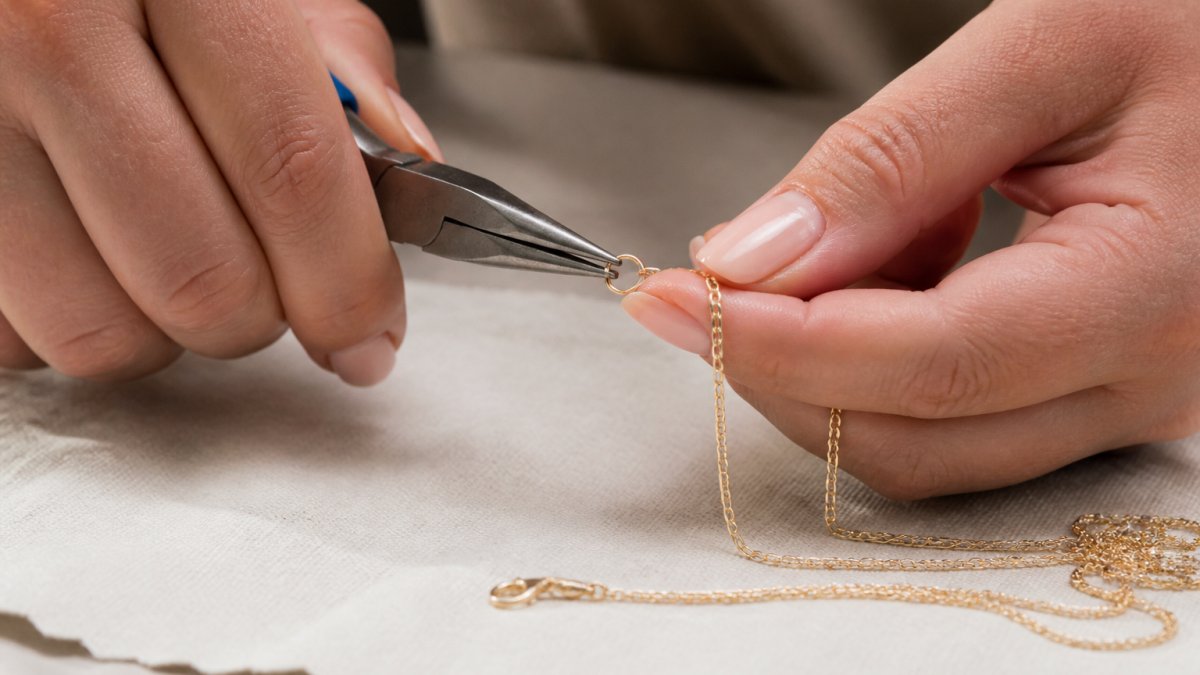
Here is the method:
- Hold the jump ring with one pair of pliers on each side of the opening.
- Twist one side forward and the other back, like opening a book.
- Never pull the ring apart sideways, which warps it out of round.
- Slide both chain ends onto the open ring.
- Twist the ring closed until the ends meet with no gap.
A gap you can feel with a fingernail means the ring will work loose again. Close it fully.
How to Fix a Broken Box Chain and Other Chain Styles
Chain construction changes the repair, and so does the metal. Two chains that look identical from arm's length can demand completely different tools. How to fix a broken box chain differs from fixing a rope or Figaro chain because a box chain is built from square links that lock together in a continuous run. When one link fails, the section behind it can unravel link by link, so the damage grows while the necklace sits in a drawer.
Match the repair to the chain style and the material:
| Chain Style | How It Breaks | Best Repair | DIY-Safe Metals |
|---|---|---|---|
| Box chain | Square links separate and unravel | Remove damaged links, reweave, or replace the section | Stainless steel; plated only with care |
| Rope chain | Twisted links wear and snap | Reconnect with a jump ring or solder | Stainless steel; solid gold and silver need solder |
| Figaro chain | Alternating links stretch open | Close the open link or replace it | Stainless steel; solid gold and silver need solder |
| Cable chain | Single round links snap | Simple jump ring reconnect | All metals, including plated |
| Snake chain | Soldered tube kinks and cracks | Professional repair only | None, soldered construction |
| Herringbone chain | Flat links crease and split | Professional repair only | None, soldered construction |
| Delicate chain | Thin links break easily | Professional repair for strength | None, too thin for home tools |
Box Chain Repair Mechanics
A box chain fails in one of two ways. Either a single square link opens at its seam, or the link itself cracks and the chain separates. An open link can sometimes be closed with chain-nose pliers, gripping the link on both sides of the seam and squeezing gently until the gap disappears. A cracked link cannot be closed, it has to come out.
Classic Heart Style Name Necklace →
Rope and Figaro Chain Repair Mechanics
Rope chains are two twisted strands of links, so a break usually means one strand has snapped while the other holds. Do not simply jump-ring the two broken ends together, the repaired section will sit crooked and take all the load. Instead, remove the damaged link on the broken strand, then reconnect that strand to its mate with a jump ring that matches the surviving link size.
Material Changes the Answer
Material decides whether a home repair is safe at all. Solid gold and sterling silver are soft and conduct heat, so a soldered joint is the only repair that restores full strength, a jump ring on a solid gold chain is a temporary fix that will wear through. Gold-plated and costume pieces have a microscopic plating layer that pliers, cutters, and heat all destroy, leaving a dull gray patch that cannot be re-plated at home.
Necklace Chain Repair Cost and When to See a Jeweler
Necklace chain repair cost depends on the metal, the damage, and whether soldering is needed. A simple jump ring fix needs only the ring itself and a few minutes at your table. A snapped solid gold or silver link that needs solder is best left to a jeweler's bench.
Ask for an estimate before any work begins, and ask specifically whether the quote includes refinishing and polishing.
When a Home Repair Is Safe
A home repair is safe when all of these are true:
- The break is at a jump ring, a spring ring, or a lobster claw that can be swapped
- The chain is stainless steel, or a plated chain you are willing to risk
- The nameplate, engraving, and any stones are untouched
When to See a Professional
Hand the piece to a jeweler when any of these apply:
- The chain is solid gold, platinum, or a high-value piece
- The break is at a solder joint or an integrated clasp
- The nameplate or engraving is damaged, bent, or lifting
For vintage jewelry or Navajo jewelry with handmade construction, use a jeweler who works with that style. A rushed home repair can undo craftsmanship that took hours to create. Confirm the jeweler has experience with personalized pieces and ask how they will protect the nameplate during soldering.
Test the Repair Before You Trust It
After any repair, home or professional, run three checks before the piece goes back on your neck:
- The fingernail test. Run a fingernail along every jump ring seam. A seam you can feel will work open again.
- The tug test. Hold the chain on both sides of the repair and pull gently, firm tension, not a yank. The joint should not shift.
- The hang test. Drape the necklace over your finger and let it hang. The repair should sit straight, with no kink or twist that will concentrate stress at one link.
Prevent the Next Break
Most repeat breaks happen at the same weak point. Rotate heavy pendants off thin chains, take name necklaces off before sleep and before anything that snags, seatbelts, scarves, gym equipment, and long hair are the usual culprits. Store chains flat or hanging rather than in a tangled pile, because tangles bend links back and forth until they fatigue.
If the chain is beyond a safe fix, replacing it protects the memory better than a weak repair.
Choosing a Replacement Personalized Necklace From Gear Luxe Co
Sometimes a chain is beyond a safe fix, and replacing it protects the memory better than a weak repair. When that happens, Gear Luxe Co makes the decision simple. Every piece is designed with care and primarily assembled and shipped from a small business factory in the USA, so you know exactly what you are getting.
Here is how we would choose:
- Signature Style Name Necklace: a contemporary font on a 16 to 18 inch adjustable cable chain, in polished stainless steel or 18K yellow gold finish, custom made with up to 10 characters.
- Classic Vertical Name Necklace: a cursive vertical design on an adjustable 16-18 inch cable chain, priced at $54.95.
- Classic Style Name Necklace: the cursive look at $39.95, available in polished stainless steel or 18K yellow gold finish.
Each comes in a soft touch gift box, and you can upgrade to a mahogany style luxury box with an LED spotlight.


Frequently Asked Questions
Can you fix a broken personalized necklace chain at home?
Yes, for many common breaks. If the chain snapped near the clasp or a jump ring opened, you can often fix it yourself with chain-nose pliers, a replacement jump ring, and a soft cloth to protect the pendant. Breaks in the middle of a solid linked chain, or damage to an engraved nameplate, are harder to fix at home. In those cases, a professional jeweler is the safer choice, especially for high-value or sentimental personalized jewelry chains.
Can a broken necklace chain be repaired with a jump ring?
A jump ring works well when the break is at the clasp or where the chain connects to the pendant. Open the jump ring with two pliers, thread both broken ends onto it, and close it firmly so the ends meet. Use a jump ring that matches the chain's thickness and metal color. For a box chain or a very delicate chain, a jump ring can add bulk, so a jeweler may solder the ends instead for a cleaner finish.
How much does necklace chain repair cost?
Simple fixes like replacing a clasp or attaching a jump ring usually cost the least, while soldering a solid chain or rebuilding a section costs more. Personalized pieces with engraving or nameplates may cost more because the jeweler has to protect the finished surface during repair. Ask for a quote before work begins, and compare it with the price of a new piece. If the repair quote is close to the cost of a replacement, a new personalized necklace is often the better value.
How can you prevent a personalized necklace chain from breaking again?
Store the necklace flat or hanging so the chain does not kink, and fasten the clasp before putting it away to stop tangles. Take it off before showering, swimming, or exercising, and keep perfume and lotion away from the chain. Check the clasp and jump rings every few months for looseness. A slightly thicker chain, like the adjustable cable chain on Gear Luxe Co name necklaces, handles daily wear better than a very fine chain.
A broken chain feels like a lost gift, but most breaks are a small fix away from being wearable again. When a repair is not worth the risk, Gear Luxe Co offers personalized name necklaces made to last, with a 100% customer satisfaction guarantee and most products assembled and shipped from the USA. Get started with Gear Luxe Co and give a meaningful piece a second life.


