


Last Updated: November 5, 2026
Quick Summary
To learn how to curate small business gift boxes, start with one occasion and a clearly defined recipient, then source products that share a theme and build the box around a single anchor item. Price each box from its full cost stack, including packaging, labor and shipping, not from a product markup. Test packing before you sell, then launch a small first run and track results.
- Pick one occasion and describe a single typical buyer in one sentence.
- Build a full cost stack per box, including packaging, labor, shipping and breakage allowance.
- Target a 40% to 60% gross margin so the business can absorb platform fees and returns.
- Test-ship sample boxes to yourself and distant addresses before selling at scale.
- Launch a small first run and track units sold, order value, returns and damage claims.
Table of Contents
- Start With a Theme and a Specific Recipient
- Estimate Your Gift Box Business Startup Costs
- Source Products That Tell a Cohesive Story
- Build the Box Around a Cohesive Experience
- Price Each Box to Protect Your Profit Margin
- Package and Ship Boxes So They Arrive Intact
- Launch Your First Curated Box and Measure Results
- Frequently Asked Questions
A well-built box, with a single story and a clear recipient, can make a gift feel personal.
Curation is the skill that separates a box people keep from one they forget. Start with the occasion and the person, then choose products that fit together. Each step below builds on the one before it.
Start With a Theme and a Specific Recipient
Every strong gift box starts with a clear reason to exist. Without one, the box becomes a random pile of products.
Choosing an occasion or theme
Pick one occasion first. Birthdays, anniversaries, nurse appreciation week and holidays each call for different items. A theme such as "date night at home" or "coffee lover's morning" gives you a filter for every product choice. For concrete date-night ideas at home, you can see how a couple-focused theme comes together.
Keep the theme narrow. A broad theme like "self-care" is hard to fill with a focused set of products.
Defining who the box is for
Name the recipient before you buy anything. A box for a romantic partner feels different from one for a coworker or a parent. Write down the recipient's age range, interests and what they would never want.
Watch out: a box built for "everyone" usually lands with no one. Narrow the audience until you can describe one typical buyer in a sentence.
Estimate Your Gift Box Business Startup Costs
Before you buy product, list what the business will cost to run. Common line items include product cost, boxes and inserts, tissue and cards, shipping supplies, website fees and any business registration costs.
Add a buffer of 10 to 15 percent for surprises. Many first-time sellers underestimate packaging and shipping costs, so price these with real quotes rather than guesses.
Source Products That Tell a Cohesive Story
Good sourcing makes curation easier. Products that share a material, color palette or origin story tend to feel like one gift instead of several. A guide to journals for documenting family memories shows how a memory-based theme can tie items together.
Vetting suppliers and checking minimum order quantities
Ask each supplier for a product sample before you commit. Check their minimum order quantity, their lead time and whether they can reorder the same item later.
Confirm that "American made" claims are backed by documentation. Ask for proof of origin before you put that claim on your packaging.
- Request samples and test them in a real box
- Confirm minimum order quantities against your budget
- Ask about lead times and restock timelines
- Verify any origin claims in writing
Planning inventory and lead times
Map out how many boxes you plan to sell each month. Then order enough stock to cover your lead time plus a safety margin. Running out of one key item can stall an entire month of orders.
Track which products sell fastest. Reorder those first, and drop slow sellers before they tie up cash.
Build the Box Around a Cohesive Experience
Think of the box as a single moment, not a collection of items. The opening should feel intentional from the first look.
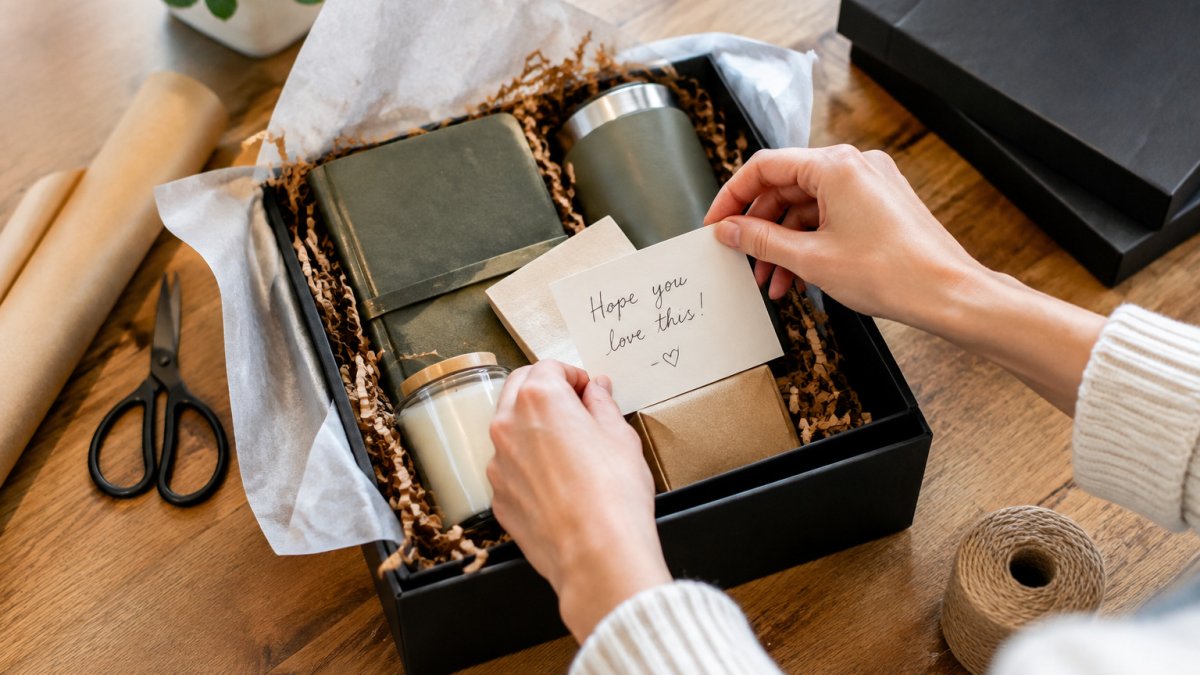
Start with one anchor item, the piece the gift is really about.
For a finishing touch, consider the Gift Wrap with Personalized Message from Gear Luxe Co. It is hand-wrapped and includes a personal note.

Keep the color and material palette to two or three tones. Too many textures make a box look busy.
Price Each Box to Protect Your Profit Margin
Pricing is where most small gift box businesses quietly lose money. A box can look profitable on the product cost alone and still lose money once packaging, labor, shipping, and payment fees are counted. Build the price from a full cost stack, not from a markup on the products.
Build a full cost stack per box
List every cost that goes into one delivered box:
Gift Wrap with Personalized Message →
- Product cost: the wholesale or landed cost of each item, including inbound freight
- Packaging: the outer box, insert or crinkle fill, tissue, ribbon, and any sleeve or label
- Printed materials: card, care instructions, and any insert with your brand story
- Labor: the minutes it takes to assemble, wrap, and pack one box, valued at an hourly rate you would pay yourself or a helper
- Shipping: the actual carrier rate for the box's dimensions and weight, not a flat guess
- Payment processing: the fee charged by your payment processor, which varies by processor and plan
- Marketplace or platform fees: if you sell through a marketplace or use a website platform, include the commission or subscription cost per order
- Breakage and replacement allowance: a small percentage set aside for damaged or lost boxes
Add these line items for one representative box. The total is your true cost per delivered box.
Work a sample box through the numbers
Suppose a three-item box has a landed product cost of $24. The outer box, insert, tissue, and ribbon come to $4.50. The printed card and insert cost $0.75. Assembly takes 12 minutes at a $15-per-hour labor rate, or $3.00.
That margin may be too thin to cover platform fees, returns, and marketing. Raising the price to $75 with the same costs lifts gross margin to about $28.14, or roughly 38%.
Set a target margin and price backward
Decide the gross margin you need before you set a price. Many small gift box sellers target 40% to 60% gross margin so the business can absorb platform fees, marketing, and returns.
Watch out: a box priced at a multiple of product cost can still lose money once labor, shipping, and fees are counted, so test the full cost stack before you publish a price.
Protect margin as costs move
Shipping rates, packaging costs, and supplier prices change. Rebuild the cost stack every quarter and after any supplier price increase. Keep a small buffer, often 5% to 10% of the price, so a rate change does not erase your margin. If a key item's cost rises, either renegotiate, substitute a comparable item, or adjust the assortment rather than silently absorbing the loss.
The article breaks down a sample box's costs and the margin each price leaves behind.
| Scenario | Total cost | Gross margin |
|---|---|---|
| Sample box at $65 price | $45.89 | about $19.11 (about 29%) |
| Same box at $75 price | $45.89 | about $28.14 (about 38%) |
| Target 50% margin at $45 cost | $45 | price must be at least $90 |
Package and Ship Boxes So They Arrive Intact
A gift box that arrives dented or rattling undoes the curation work. Treat packing as an operational system: test it, measure it, and assemble in batches so every box ships the same way.
Run a packing test before you sell
Build three sample boxes exactly as a customer would receive them. Ship one to yourself locally, one to a nearby state, and one across the country if you plan to sell nationally. For a protective option built for these shipments, see package protection options. Open each on arrival and check for crushed corners, shifted items, broken seals, and rattling. Photograph the results. If anything moves, add fill or switch to a snugger box. Repeat the test after any packaging change or new fragile item.
Prevent breakage with structure, not just padding
Use a box sized to the contents so items cannot slide. Put fragile items at the center, away from the walls, and fill every void so nothing shifts when the box is tilted. Wrap glass or ceramic in bubble wrap or tissue and tape it in place rather than letting it float.
Watch out: overfilling a box can bulge the seams and cause the carrier to reject or repack it, so leave a small gap for the lid to close flat.
Control dimensional weight and shipping cost
Carriers bill by dimensional weight when a box is large relative to its actual weight, so an oversized box with light contents can cost more to ship than a smaller, denser one. Measure the packed box's length, width, and height, and compare the dimensional weight to the actual weight. If dimensional weight is higher, reduce the box size or repack more tightly.
Plan for seasonal cutoffs and batch assembly
Carriers typically publish holiday shipping cutoffs each year, and orders placed after those dates may not arrive on time (2026 Holiday Shipping Deadlines). Build your production calendar backward from the cutoff: set an order deadline that leaves time for assembly, packing, and carrier pickup. During peak season, assemble boxes in batches rather than one at a time.
Track damage and tighten the process
Record every damage claim and note what failed: crushed corner, broken item, shifted contents, or wet packaging. Review the log monthly. If one item breaks repeatedly, change its wrap or position. If one box size fails, switch sizes. A damage rate that stays high erodes margin and reviews, so treat each claim as a signal to adjust the packing method rather than a one-off cost.
Launch Your First Curated Box and Measure Results
Start with a small run of boxes, not a full catalog. This lets you learn what buyers actually want before you commit to more stock.
After launch, track a few numbers each month: units sold, average order value, return rate and damage claims. Compare these against your startup cost estimate to see whether the business is on track.
Ask buyers for feedback. A short follow-up email asking what they liked and what they would change will show you where to improve the next box.
Frequently Asked Questions
How do I curate gift boxes for a small business?
Start with one occasion and one clearly defined recipient, such as a birthday gift for a new parent or a thank-you box for nurses. Choose three to five products that share a theme, color palette or purpose. Test the combination with a few friends or existing customers before you list it. Keep the selection small at first so you can source consistently, control costs and learn which items people actually reorder. Expand the lineup only after you see which combinations sell and generate repeat orders.
How much does it cost to start a gift box business?
Startup costs depend mostly on the number of products you stock, your packaging choices and whether you buy inventory before you have orders. Budget for initial product samples, boxes and inserts, shipping supplies, a business license and an online storefront. Many small operators begin with a small first run of boxes to limit upfront inventory. Track every cost per box from the start, because that number determines the price you can charge and the profit you keep.
How do I price gift boxes so I make a profit?
Add up the landed cost of every item in the box, including packaging, inserts, gift wrap and a share of labor. Then add the cost of shipping materials and any payment processing fees. Apply a markup that covers these costs and leaves room for profit, and check that the final price still feels fair for the gift it provides. Recalculate whenever a supplier changes its prices, because small increases can quietly erase your margin.
What packaging keeps gift boxes safe during shipping?
Use a sturdy outer mailer box sized so the contents do not shift, then add inner cushioning such as molded inserts, kraft paper or padded wrap around fragile items. Seal every seam with strong tape and test your packing method by shaking a sample box before shipping. Include clear handling instructions if the contents are breakable. Good packaging protects the product and makes the unboxing experience feel intentional.
Curating a small business gift box comes down to one clear theme, a specific recipient and products that fit together. Gear Luxe Co builds its gifts with that same focus, and the team stands behind every order with a 100% customer satisfaction guarantee. Shop Now to see how a thoughtful gift can come together.


