


Table of Contents
- Why Personalized Sterling Silver Jewelry Needs Special Care
- Daily Wear and Preventative Care for Your Sterling Silver Jewelry
- How to Clean Sterling Silver at Home
- How to Remove Tarnish from Personalized Jewelry
- How to Store Sterling Silver Jewelry to Prevent Tarnish
- The Importance of Polishing Cloths and Buffing
- Conclusion
- Frequently Asked Questions
Last Updated: October 1, 2026
Why Personalized Sterling Silver Jewelry Needs Special Care
Personalized sterling silver jewelry tarnishes faster than plain silver pieces, because engraved names and dates create tiny valleys where moisture and sulfur collect. Sterling silver is an alloy of 92.5% pure silver and 7.5% other metals, usually copper, and that copper is the first thing to react with the air around it. At Gear Luxe Co, we explain this to customers every week, because a name necklace is meant to last a lifetime, not a season.

Daily Wear and Preventative Care for Your Sterling Silver Jewelry
Preventative care is the cheapest form of jewelry care, and it takes almost no effort. The goal is simple: keep moisture and chemicals off the metal. Every time you remove those two things, you add months to the piece.
When to Remove Your Jewelry
Take your sterling silver jewelry off before these five activities:
- Showering and swimming. Soap film and chlorine both speed up tarnish.
- Cleaning. Household cleaners are harsh chemicals that strip the metal.
- Applying lotion, perfume, or sunscreen. Let each one dry first.
- Cooking with onions, eggs, or garlic. These foods release sulfur.
- Exercising. Sweat is salty and mildly acidic.
How to Clean Sterling Silver at Home
The safest home method for how to clean sterling silver at home is mild dish soap, warm water, and a soft-bristled brush. Skip the toothpaste, baking soda paste, and vinegar soaks you see online. Those are abrasives, and abrasives scratch silver.
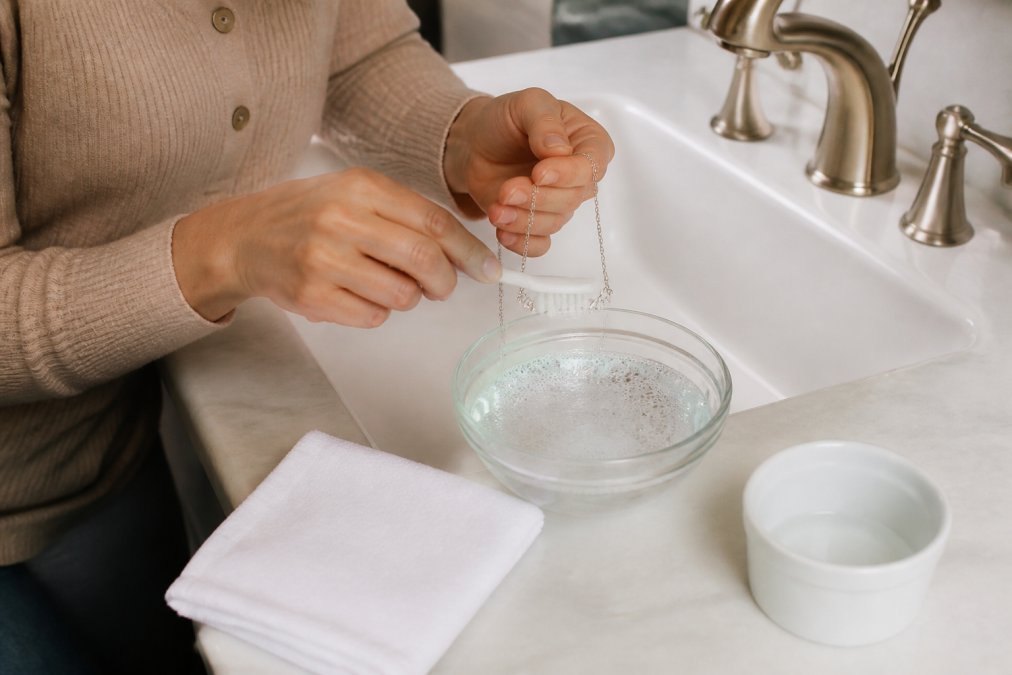
Here's the full method, step by step:
- Fill a small bowl with warm water and one drop of mild dish soap.
- Soak the piece for two to three minutes. No longer.
- Dip a soft-bristled brush, like a baby toothbrush, into the soapy water.
- Brush gently in small circles, working into the letters of the engraving.
- Rinse under warm running water. Plug the drain first.
- Blot dry with a lint-free cloth. Never rub.
- Let the piece air dry for ten minutes before wearing or storing it.
Safe Cleaning Solutions vs. Harsh Chemicals
Safe options are mild dish soap, warm water, and a soft-bristled brush. Harsh chemicals, including bleach, ammonia, and chlorine, damage the metal and can strip a protective coating.
- Ultrasonic cleaners. These vibrate dirt loose with sound waves. They work well on plain silver but can loosen small stones or delicate soldered charms on personalized pieces.
- Ionic cleaners. These use a chemical reaction to reverse tarnish without touching the metal. They're gentle, but they won't remove grime from inside engraving.
How to Remove Tarnish from Personalized Jewelry
The best way to remove tarnish from personalized jewelry depends on how the personalization was made. Most guides hand you one method and call it done. That's the mistake. A laser-engraved name, a hand-stamped initial, and a blackened or oxidized letter all sit on the same sterling silver base, but each one reacts to polish differently, and the wrong technique can erase the very detail you paid for.
Laser-Engraved Personalization
Laser engraving cuts a shallow, precise groove with clean edges and a uniform depth. It's the most common finish on modern name necklaces, bar pendants, and coordinate pieces.
- Tarnish pattern: darkening starts as a thin film across the whole engraved area, not just the deepest point.
- Safe method: mild dish soap, warm water, and a soft-bristled brush, worked in small circles inside the letters. Follow with a silver polishing cloth on the flat surface only.
- Avoid: silver dip left to sit. The chemical reaches the full depth of a shallow groove fast and can dull the crisp edge the laser cut.
- Why it matters: laser grooves are shallow, so abrasive paste wears the letter walls down faster than it would on a deeper cut.
Hand-Stamped Personalization
Hand-stamped lettering is pressed into the metal with a steel punch. The groove is deeper and the edges are slightly raised, which is exactly why it collects more debris.
- Tarnish pattern: black residue packs into the bottom of each stamp and along the raised rim.
- Safe method: soak two to three minutes in mild soapy water, then use a soft-bristled brush with a gentle scrubbing motion aimed straight into the groove. A wooden toothpick can lift packed residue from a wide stamp without scratching the silver.
- Avoid: polishing cloths pressed hard across the face of the piece. The raised rim catches the cloth and the abrasive drags metal across the flat surface, leaving a smeared finish.
- Why it matters: the deeper the stamp, the longer tarnish takes to reach the bottom, but the harder it is to get out once it does.
Blackened or Oxidized Personalization
Blackened lettering is a deliberate finish, usually a sulfide or oxide layer applied to the recessed area so the name stands out against bright silver. It is not tarnish, even though it looks similar.
- Tarnish pattern: the bright surface around the letters tarnishes normally, while the black fill stays dark until it's worn away.
- Safe method: clean the flat surface with soap and water, then buff only the unblackened areas with a polishing cloth. Keep the cloth off the letters.
- Avoid: silver dip, ultrasonic cleaners, and any polishing cloth rubbed across the engraving. All three strip the black finish, and once it's gone the name loses its contrast and definition.
- Why it matters: a stripped oxidized finish usually means a trip to a jeweler to have the recess re-blackened, which is a service, not a home fix.
The General Order That Works for All Three
- Wash the piece first with mild dish soap to remove oils and skin residue.
- Dry it completely with a lint-free cloth.
- Match the method to the personalization type above.
- Rinse, blot dry, and buff the flat surfaces with a clean polishing cloth.
- Repeat once if needed. Stop after two rounds.
If the letters are still dark after two rounds, a jeweler can restore the piece with professional tools. That's not a failure on your part. Deep tarnish inside fine engraving is genuinely hard to reach at home, and a professional can clean the recess without flattening the detail.
Classic Heart Style Name Necklace →
How to Store Sterling Silver Jewelry to Prevent Tarnish
The right way to store sterling silver jewelry to prevent tarnish is an airtight container with an anti-tarnish strip, kept away from humidity and sunlight. Air is the enemy. Cut off the air and tarnish slows to a crawl.
- Keep pieces separate. Chains scratch pendants when they tangle.
- Use an airtight container with a sealed lid, not an open dish.
- Add an anti-tarnish strip and replace it every few months.
- Store in a cool, dry spot. Bathrooms are the worst choice.
- Fasten the clasp before storing, so the chain doesn't knot.
Home Storage by Personalization Type
A single storage method doesn't fit every personalized piece. The finish changes what you need to protect.
- Laser-engraved pieces: the shallow groove is the vulnerable spot, so keep the piece flat or hanging rather than piled in a dish where the engraved face rubs against other metal. A lined jewelry tray with individual slots works well.
- Hand-stamped pieces: the raised rim around each letter is the first thing to wear, so avoid stacking. A pouch per piece, or a divided tray, keeps the rims from grinding against neighbors.
- Blackened or oxidized pieces: the black fill is a surface finish, so friction is the enemy. Store these in a soft pouch with no metal contact, and never in a shared compartment with chains.
Travel Storage for Personalized Pieces
Travel is where most damage happens, because humidity and movement work together. This is the part most care guides skip entirely, and it's the part that matters most for a piece you can't replace.
Build a small travel kit before you pack:
- One soft pouch per personalized piece. Pouches are cheap and they prevent the metal-on-metal contact that scratches engraving.
- A hard case for the pouches. A small hard-shell case keeps the pouches from being crushed in a carry-on.
- One anti-tarnish strip inside the case. Replace it after a long trip.
- A zip-top bag with the air pressed out as a backup for a single piece. It's not as good as a pouch and case, but it beats a toiletry bag.
A few travel rules that save pieces:
- Never pack jewelry loose in a toiletry bag. Moisture from shampoo and lotion will find it, and the bottle caps will scratch it.
- Wear the piece through airport security rather than packing it when you can. It stays on your body, away from humidity and movement.
- Take the piece off before swimming in a pool or the ocean. Chlorine and salt both accelerate tarnish, and neither is kind to a blackened finish.
- Don't leave the case in a hot car or a checked bag. Heat and humidity inside a closed car or cargo hold push tarnish faster than anything else on this list.
- Dry the piece completely before it goes back in the pouch. A single drop of water sealed in with the metal undoes the whole point of the airtight case.
The Importance of Polishing Cloths and Buffing
A polishing cloth is the single most useful tool you'll own, and it costs less than a coffee. These cloths are treated with a mild cleaning agent, so the buffing action removes light tarnish as you wipe.
Conclusion
Caring for a personalized piece takes about two minutes a week, and that small habit is the whole difference between a necklace that stays bright and one that ends up in a drawer. The pieces worth protecting are the ones with meaning behind them, and those deserve better than a quick wipe with a tissue.
Frequently Asked Questions
How often should I clean my personalized silver jewelry?
Clean your sterling silver jewelry every two to four weeks with a polishing cloth, and do a deeper clean with mild dish soap and warm water every one to two months. If you wear it daily, tarnish and body oils build up faster, so a quick wipe after each wear helps. Pieces worn only for special occasions may need cleaning every few months. Always check engraving grooves for buildup, since those areas trap residue and dull the shine.
Can I shower with my 925 sterling silver necklace?
It's best to remove sterling silver jewelry before showering. Soap scum, shampoo residue, and minerals in water leave a film that dulls the shine and speeds up tarnish. Hot water and steam can also loosen clasps or damage delicate personalized components. If you forget occasionally, dry the piece right away with a soft lint-free cloth. For daily wear, put jewelry on last, after lotions and perfume have dried, to keep chemicals off the metal.
Is Dawn dish soap safe for cleaning sterling silver jewelry?
A few drops of mild dish soap in warm water is a safe, gentle option for most sterling silver. Avoid harsh chemicals, bleach, ammonia, or abrasive cleaners, which can scratch the surface or strip a protective coating. Use a soft-bristled brush to reach inside engravings, then rinse and blot dry with a lint-free cloth. For pieces with gemstones or delicate finishes, stick to a polishing cloth and skip the water bath entirely.
What is the best way to store sterling silver to prevent oxidation?
Store each piece in an airtight container or a tarnish-resistant pouch lined with anti-tarnish strips. Keep jewelry away from humidity, direct sunlight, and areas like bathrooms where moisture lingers. A cool, dry drawer works well. For personalized pieces with engravings, add a small silica gel packet to absorb moisture. Separating items prevents scratches and chain tangles, and storing them dry after cleaning slows oxidation significantly.


