


Table of Contents
- Why Anniversary Watch Size Matters
- How to Measure Wrist Size for a Watch
- Watch Case Diameter Guide for Different Wrist Sizes
- How Should a Watch Fit on Your Wrist
- Understanding Lug-to-Lug Length and Strap Width
- How to Adjust a Watch Bracelet After Purchase
- Choosing Anniversary Watch Size by Style and Occasion
- Common Mistakes to Avoid When Selecting Anniversary Watch Size
- Frequently Asked Questions
Last Updated: October 10, 2026
Why Anniversary Watch Size Matters
Choosing an anniversary watch size isn't just about picking something that looks nice. The right fit affects comfort, style, and how often your partner actually wears the gift. A watch that's too large can slip around and feel awkward. One that's too small might disappear on the wrist or look out of proportion. Getting the sizing right means the watch becomes a treasured everyday piece instead of something that sits in a drawer.
Sizing a watch follows clear rules based on wrist measurements and proportions. Once you understand these fundamentals, picking the perfect anniversary watch size becomes straightforward.
How to Measure Wrist Size for a Watch
Accurate measurement is essential. You need to know the wrist circumference in inches, which guides every decision about case diameter and strap width.
Measuring Your Own Wrist
Wrap a soft measuring tape around your wrist just below the wrist bone, where a watch normally sits. Keep it snug but not tight, you should slip one finger underneath comfortably. Write down the measurement in inches.
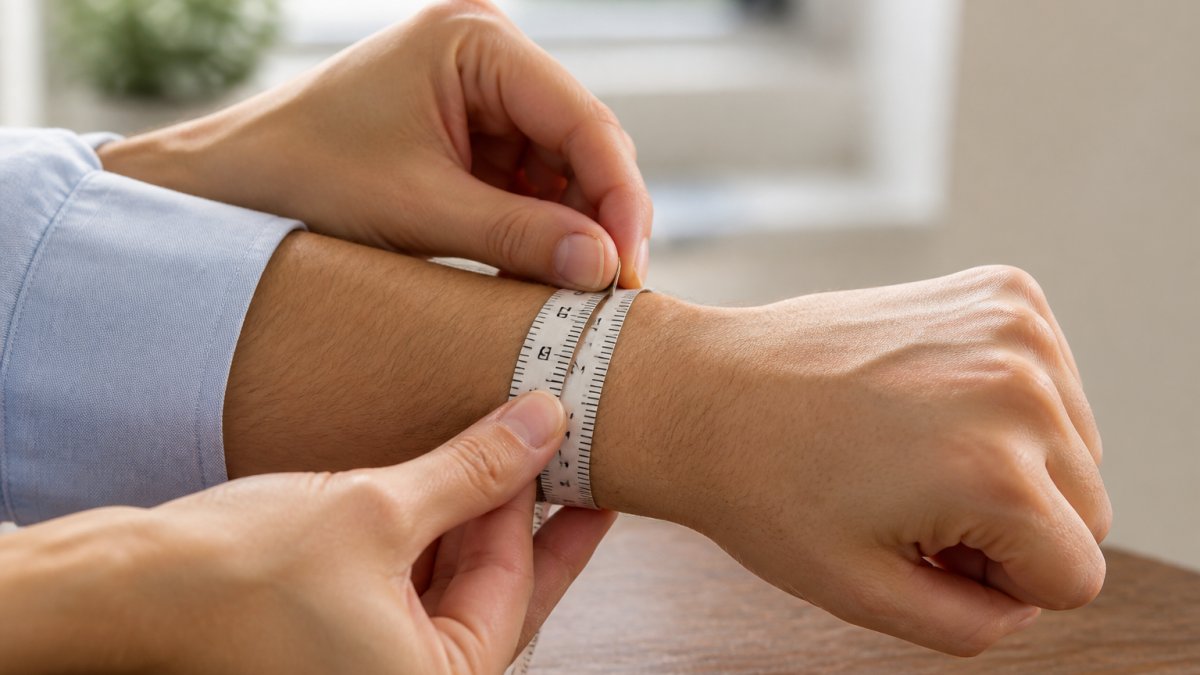
Measuring Someone Else's Wrist Discreetly
Borrow a watch they wear regularly and measure its inner circumference. Alternatively, measure a bracelet they wear, or ask a trusted friend or family member who knows their wrist size.
Watch Case Diameter Guide for Different Wrist Sizes
Case diameter, measured in millimeters across the watch face, determines whether a watch looks proportional on a wrist.
Small Wrists (Under 6.5 inches)
For wrists under 6.5 inches, case diameters between 34mm and 38mm work best. A 36mm case is often the sweet spot.
Average Wrists (6.5 to 7.5 inches)
Average wrists (6.5 to 7.5 inches) have the widest range of options: 38mm to 42mm. A 40mm case is the modern standard and suits most people in this range.
Larger Wrists (Over 7.5 inches)
Larger wrists (over 7.5 inches) need case diameters between 42mm and 46mm to look proportional. A 44mm case often works well for this group.
How Should a Watch Fit on Your Wrist
Beyond case diameter, the actual fit matters for daily comfort. A watch that fits correctly will be worn every day. One that doesn't will end up unworn.
The One-Finger Rule
A properly fitted watch should have about one finger's width of space between the watch case and your wrist bone. Your finger should slip underneath the strap easily but not loosely.
Dial Proportions and Wrist Coverage
The watch dial should cover roughly one-third to one-half of your wrist width for visual balance. Place the watch on your wrist and check if the proportions look balanced.
Case Thickness and Everyday Comfort
Case thickness matters for comfort. A thick watch (over 15mm) can catch on shirt cuffs. For daily wear, a thickness between 10mm and 13mm offers the best balance.
Understanding Lug-to-Lug Length and Strap Width
Strap width should match the case size proportionally: a 40mm watch typically uses a 20mm strap, and a 42mm watch usually takes a 22mm strap. When choosing an anniversary watch from Gear Luxe Co, verify that the strap width matches the case diameter for balanced proportions.
How to Adjust a Watch Bracelet After Purchase
Even with perfect sizing, many watches arrive slightly loose or tight. Adjustments are simple and take minutes.
Metal Bracelet Link Removal
Metal bracelets use removable links. Remove links from the sides equally to maintain balance, testing the fit after each removal. Most people remove 1-3 links total.
Leather Strap Micro-Adjustments
Leather straps have multiple holes for adjustment. Most offer 4-6 adjustment points, allowing you to dial in the perfect fit and tighten as the leather stretches with wear.
Choosing Anniversary Watch Size by Style and Occasion
The ideal anniversary watch size depends on wrist measurements and how your partner will actually wear it. Understanding the relationship between watch style, case size, and real-world wearability ensures your gift becomes a daily companion.
Dress Watches for Formal Anniversaries and Professional Settings
Dress watches are designed to disappear under a dress shirt cuff or blouse sleeve, prioritizing elegance and refinement.
Ideal case diameter: 36mm to 40mm Typical thickness: 8mm to 11mm Strap width: 16mm to 18mm Best for: Partners who wear business attire regularly, formal anniversary dinners, or those who prefer understated luxury
Dress watches work best if your partner wears long sleeves to work or regularly attends formal events. Verify wrist size before choosing, a 36mm dress watch on a large wrist will look small, while a 40mm on a small wrist may be too large. Dress watches typically have leather straps, which require more maintenance and are less suitable for active lifestyles.
Consider dress watches if:
- Your partner wears business casual or formal clothing most days
- They value understated elegance over bold design
- The anniversary celebration includes a formal dinner or event
- They already own and wear dress watches
Avoid dress watches if:
- Your partner works in casual environments (tech, creative, trades)
- They prefer sporty or casual clothing
- They work outdoors or with their hands
- They have a large wrist and prefer proportional sizing
Sport Watches for Active Couples and Outdoor Lifestyles
Sport watches are built for durability and functionality, featuring larger cases, thicker profiles, and robust materials designed to withstand activity.
Ideal case diameter: 42mm to 46mm Typical thickness: 12mm to 15mm Strap width: 20mm to 24mm Best for: Partners with active lifestyles, outdoor enthusiasts, or those who work in demanding environments
Sport watches are the right choice if your partner hikes, runs, plays sports, or spends significant time outdoors. They typically come with metal bracelets or rubber straps, both more durable and easier to clean than leather. However, sport watches are visually bold and may feel out of place in formal professional settings.
Men Silver Stainless Steel Waterproof Watches →
Consider sport watches if:
- Your partner has an active lifestyle (hiking, running, sports, outdoor work)
- They prefer bold, visible design
- They work in casual environments
- They already own and wear sport watches
- The anniversary celebration involves an outdoor activity or adventure
Avoid sport watches if:
- Your partner works in formal or business-formal environments
- They prefer subtle, understated style
- They have a small wrist and prefer proportional sizing
- They rarely engage in athletic activity
Everyday Watches for Versatile, All-Occasion Wear
Everyday watches split the difference between dress and sport watches, making them the most practical anniversary gift choice for most people.
Ideal case diameter: 38mm to 42mm Typical thickness: 10mm to 13mm Strap width: 18mm to 20mm Best for: Partners who value versatility, those with mixed professional and casual lifestyles, or anyone who wants one watch that works for any occasion
Everyday watches work across contexts and are ideal if you're unsure about your partner's preferences or lifestyle. Many come with interchangeable straps, allowing your partner to adjust the look depending on the occasion. The trade-off is that they don't excel in any single area, but for most people, this balance is exactly what they need.
Consider everyday watches if:
- Your partner has a mixed lifestyle (some formal work, some casual time)
- You're unsure about their style preferences
- They don't currently wear watches regularly
- They value versatility and want one watch for all occasions
- The anniversary celebration spans multiple settings (dinner, activity, casual time)
Avoid everyday watches if:
- Your partner has a clearly defined lifestyle (purely formal or purely active)
- They already own watches and have strong style preferences
- They prefer watches optimized for a specific purpose
Matching Watch Size to Wardrobe and Climate
Beyond style category, consider your partner's actual wardrobe and climate.
Long-sleeve environments: If your partner wears long sleeves most of the year (business attire, cold climate), case thickness matters less because the watch will be hidden under sleeves.
Short-sleeve environments: If they wear short sleeves most of the time (warm climate, casual work), a thinner profile (10mm to 12mm) is more comfortable and looks better proportionally.
Casual wardrobe: If they wear jeans, t-shirts, and casual clothing most days, a sport watch (42mm to 46mm) or casual everyday watch (40mm to 42mm) feels more natural.
Using the Anniversary Occasion to Guide Style Choice
The specific anniversary milestone or celebration can also inform your choice.
Milestone anniversaries (5, 10, 25, 50 years): These often call for something refined and timeless. A dress watch or elegant everyday watch signals the significance of the occasion.
Active anniversary celebrations (hiking trip, adventure travel, sports event): A sport watch or rugged everyday watch matches the activity and becomes a memory of the experience.
Romantic or formal celebrations (dinner, weekend getaway, renewal of vows): A dress watch or refined everyday watch complements the occasion's elegance.
Casual or surprise anniversaries: An everyday watch is the safest choice because it works regardless of how the celebration unfolds.
Common Mistakes to Avoid When Selecting Anniversary Watch Size
Several predictable mistakes trip up gift-givers. Knowing these helps you avoid them.
Assuming bigger is always better. Many people think a larger watch is more impressive.
Ignoring strap width proportions. A beautiful watch with a mismatched strap width looks unbalanced. Always verify that strap width complements the case diameter.
Forgetting to account for clothing. A thick watch that catches on shirt cuffs creates frustration. Consider the wearer's typical wardrobe when choosing case thickness.
Skipping the measurement step. Guessing a wrist size leads to poor fits. Spend five minutes measuring.
Overlooking adjustment options. Even perfectly sized watches sometimes need tweaking. Choose a watch with adjustable straps or bracelets that allow fine-tuning after purchase.
| Mistake | How to Avoid It | Impact |
|---|---|---|
| Choosing oversized watch | Match case to wrist circumference | Watch worn daily vs. rarely |
| Mismatched strap width | Verify strap width matches case | Balanced proportions vs. awkward look |
| Case too thick for wardrobe | Choose 10-13mm profile | Comfortable wear vs. catching on cuffs |
| Skipping measurement | Measure wrist before choosing | Right fit vs. poor fit |
| No adjustment options | Pick adjustable strap or bracelet | Fine-tuning possible vs. permanent fit issues |
Choosing the right anniversary watch size comes down to three steps: measure the wrist accurately, match the case diameter to that measurement, and verify the strap width creates balanced proportions. Gear Luxe Co's collection includes options across all size ranges, from the elegant My Husband My Love Black Chronograph Watch with its precise 38.1mm case to the bold Dad's Love Wooden Watch at 45mm.


Frequently Asked Questions
How do you measure wrist size for a watch?
Wrap a soft measuring tape around your wrist just above the wrist bone, where you'd normally wear the watch. Keep the tape snug but not tight, you should be able to fit one finger underneath. Record the measurement in inches. For someone else's wrist, measure a watch they already wear by placing it on a flat surface and measuring the inside of the band from the first hole to where it currently fastens. This gives you their typical wearing size.
What case diameter is best for a small wrist?
Wrists under 6.5 inches typically suit case diameters between 36 mm and 40 mm. A 36 mm case offers a dress-watch proportion, while 38-40 mm provides everyday versatility without overpowering the wrist. Avoid cases larger than 42 mm, as they'll appear unbalanced. The key is ensuring the watch dial doesn't extend beyond your wrist width on either side, a good visual test of proper fit.
How should an anniversary watch fit on the wrist?
A properly fitted anniversary watch should sit flat against your wrist with the lugs (the bars holding the strap) hugging your wrist naturally. You should be able to slide one finger under the band when fastened, this is the one-finger rule. The watch shouldn't rotate around your wrist or slide up and down. If it's too loose, you can adjust metal bracelets by removing links or add holes to leather straps. A comfortable fit ensures the watch stays in place during daily wear and gift-giving occasions.
Can you adjust a watch bracelet after giving it as a gift?
Yes, most watch bracelets can be adjusted after purchase. Metal bracelets use removable links that can be taken out with a pin tool to tighten the fit. Leather straps can be adjusted by punching additional holes or using a micro-adjustment clasp. This flexibility means you can order an anniversary watch without worrying about exact sizing, your recipient can easily have it fitted to their wrist for maximum comfort.


