


Table of Contents
- Start With the Hallmarks on Gold Jewelry Explained
- The Difference Between Gold Plated and Gold Filled
- How to Identify Real Gold Jewelry at Home
- Inspect Prongs, Settings, and Clasps
- Examine Weight, Density, and Gemstones
- Use Certification, Appraisal, and Digital Authentication
- Conclusion
- Frequently Asked Questions
Last Updated: September 5, 2026
Learning how to tell if jewelry is high quality comes down to a handful of observable clues, not guesswork or brand names. Before you spend money on a piece meant to last, you can check its hallmarks, test its weight, and inspect how it was assembled. High-quality jewelry resists wear, holds its color, and survives daily life without bending or breaking. The difference between fine jewelry and costume jewelry usually shows up in the metal itself, how stones are set, and the finishing details. A thorough evaluation combines visual inspection, simple at-home tests, and documentation, no jeweler's loupe or chemistry degree required.

Start With the Hallmarks on Gold Jewelry Explained
Hallmarks on gold jewelry explained simply: they are tiny stamped numbers or letters that state the metal's purity. Look inside the band of a ring, on the clasp of a necklace, or on the back of an earring post. A stamp reading 10K, 14K, or 18K tells you the karatage, which is the ratio of pure gold to alloyed metals. Pure gold is 24K, but it is too soft for everyday wear, so jewelers mix it with other metals for durability.
The Federal Trade Commission's jewelry guides explain that these quality marks are voluntary but regulated when present. If a piece is stamped, the mark must accurately reflect the actual gold content. A common mistake is assuming a higher karat always means better. For an everyday necklace or ring, 14K offers the best balance of color, strength, and value. Higher karat gold resists tarnish but scratches more easily, while lower karat gold is harder but can trigger skin reactions in sensitive people.
The Difference Between Gold Plated and Gold Filled
The difference between gold plated and gold filled is thickness, and thickness determines how long the piece will last. Gold plated jewelry has a microscopic layer of gold bonded to a base metal, often brass or copper. This layer wears away in months, revealing the dull base metal underneath. Gold filled jewelry has a much thicker layer of gold mechanically bonded to the base, making it far more durable for daily wear.
Look for the stamps: gold plated pieces often say "GP" or "HGE" (heavy gold electroplate), while gold filled pieces are marked "GF" or show a fraction like "1/20 14K GF." That fraction means the piece is 5% gold by weight, which is substantial. If you are buying a personalized gift meant to be worn often, gold filled is the smarter choice. It resists tarnish and holds up to sweat, lotion, and washing without losing its finish.
How to Identify Real Gold Jewelry at Home
You can learn how to identify real gold jewelry at home using a few simple methods, but no single test is conclusive on its own; the goal is to build a body of evidence that points toward authenticity.
The Magnet Test: A Quick Screen, Not a Verdict
Start with the magnet test. Gold is not magnetic, so a genuine gold piece will not stick to a strong neodymium magnet. This test catches obvious fakes, but it is not conclusive: many non-gold metals are also non-magnetic. A piece that sticks is definitely not solid gold, but one that does not stick could still be gold plated over a non-magnetic base metal.
To perform the test properly, use a strong magnet (rare-earth magnets work best, not the weak ones on refrigerator doors). Hold the piece by a non-metal part, like a chain or a cloth, and bring the magnet close. Watch for any pull, even a slight one. A genuine gold piece will show zero attraction.
The Weight and Density Check: Feel the Heft
Gold is one of the densest metals commonly used in jewelry. A cubic centimeter of pure gold weighs about 19.3 grams, versus 10.5 grams for silver and 8.5 grams for brass (periodictable.com). A genuine gold piece should feel noticeably heavier than a similarly sized piece made of base metal.
Hold the piece in your palm and compare it to a known piece of jewelry of similar size; if it feels too light, that is a red flag. For a more precise check, perform a water displacement test: fill a graduated cylinder with water, record the volume, submerge the piece, and record the new volume. The difference is the piece's volume in cubic centimeters. Weigh the piece in grams, then divide the weight by the volume. If the result is close to 19.3 for 24K gold, 15.6 for 18K gold, or 14.5 for 14K gold, that is strong evidence of authenticity. This test works well for solid metal items like chains or plain bands, though hollow pieces or those with gemstones will throw off the calculation.
The Ceramic Test: Use with Caution
The ceramic test carries risk. Drag the piece gently across an unglazed ceramic tile (the back of a bathroom tile works). Real gold leaves a yellow streak, while base metals leave a gray or black mark. But this test can scratch the surface, especially on gold plated or gold filled pieces, exposing the base metal and ruining the appearance. Only use it on a piece you are willing to risk damaging, and always test on an inconspicuous area like the inside of a band or the back of a pendant.
The Acid Test: Leave It to the Professionals
For a definitive answer, take the piece to a professional jeweler for acid testing. The jeweler will make a tiny scratch on the piece and apply a drop of nitric acid of a specific concentration. The reaction, or lack of one, confirms the karatage. For example, 14K gold will resist nitric acid, while 10K gold will show a slight reaction. This test is destructive to the surface, which is why jewelers do it on an inconspicuous spot.
When to Skip At-Home Tests Entirely
At-home tests are most useful for screening pieces you already own or are considering buying in person. For high-value purchases or pieces with complex settings, skip the DIY approach and go straight to a certified appraiser or reputable jeweler. A common pattern among buyers who get burned is relying on a single at-home test, usually the magnet test, and assuming it is enough. Treat at-home tests as a first pass, not a final answer.
Inspect Prongs, Settings, and Clasps
The craftsmanship of a piece reveals itself in the prongs, settings, and clasp, where stress concentrates. High-quality prongs are thick enough to hold a stone securely and sit flush against the gemstone with no gaps. Run your finger over the setting; a well-made piece feels smooth, with no sharp edges catching on fabric or skin. The clasp should snap shut with a firm, positive click and open without excessive force.
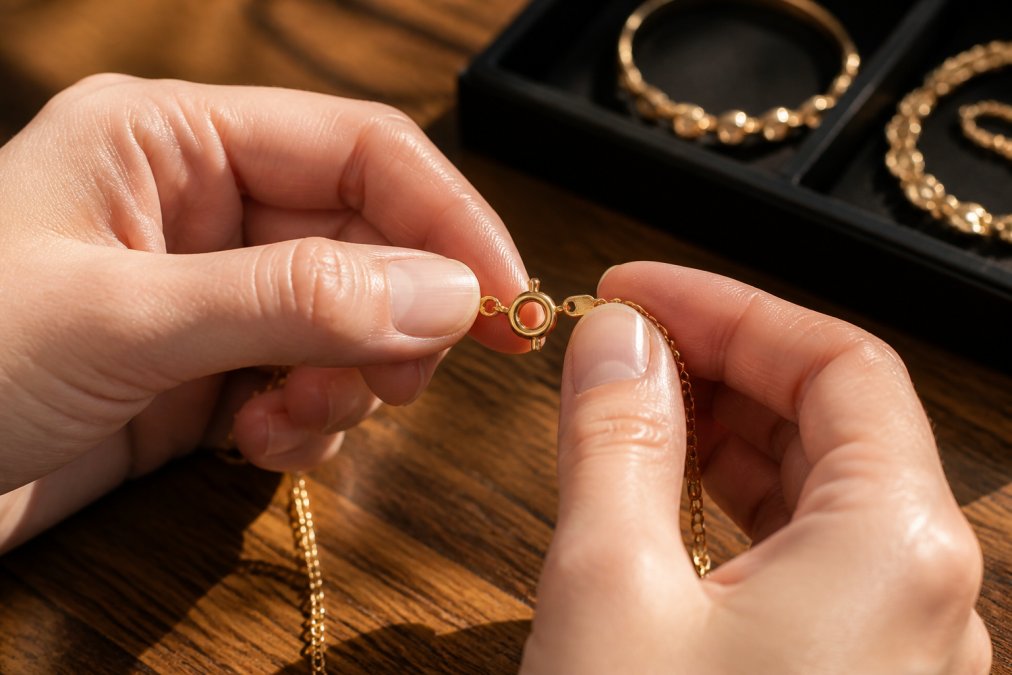
A common issue with lower-quality jewelry is a hollow or flimsy clasp that bends under pressure. Check the jump rings, the small circles connecting the clasp to the chain; they should be soldered closed, not just pinched shut. Look at the overall symmetry of the piece. A pendant should hang straight, and a chain should lie flat when coiled. These details tell you whether the maker took pride in the construction or rushed it out the door.
Examine Weight, Density, and Gemstones
Weight and density are honest indicators of quality because they are hard to fake. A solid gold or sterling silver piece has a satisfying heft, while costume jewelry feels light and hollow. Gold is nearly twice as heavy as lead, and sterling silver is noticeably denser than base metals.
How Weight Predicts Longevity
Weight is not just about feel, it is a direct predictor of how the piece will wear over time. A substantial chain resists kinking and breaking; a pendant with heft hangs properly rather than flipping over. A thin, lightweight band will bend out of shape with everyday wear, while a heavier band will hold its roundness. Ask yourself: will this survive five years of daily use? If the metal feels insubstantial, the answer is likely no.
Gemstone Quality: Look for the Flaws
For gemstones, examine the clarity and cut. Real stones usually have tiny internal inclusions visible under magnification, while glass or plastic imitations look too perfect. Check the facets for sharp edges and even symmetry; a well-cut stone reflects light consistently. Be cautious of stones glued into their settings; quality pieces use prongs or bezels. A common mistake is assuming a larger stone means more value; a smaller, high-quality stone set in solid gold often outperforms a large, low-grade stone in a plated setting.
The Ethical Quality Check: Sourcing Matters
Modern quality is also about where the materials came from. A piece made with recycled gold or sterling silver has a lower environmental footprint than one made with newly mined metal, and recycled metals are chemically identical, so you do not sacrifice quality. Many reputable jewelers now use 100% recycled gold and silver as a standard practice and state this clearly in their product descriptions.
For diamonds and colored gemstones, ask about the source. Conflict-free diamonds are certified under the Kimberley Process, which aims to prevent the trade of stones that fund armed conflict. However, the Kimberley Process has known gaps, so some jewelers go further by offering traceable stones with a documented chain of custody from mine to market. Lab-grown diamonds and gemstones are another ethical option. They are chemically and physically identical to mined stones, but they cost significantly less, typically 20% to 40% less than a comparable mined diamond, and they come with no questions about their origin.
How Quality Manifests Over Time
Quality is not just how a piece looks on day one, it is how it looks after a year of wear. Solid gold and sterling silver develop a natural patina over time. Gold may develop minor scratches, but it will not flake or peel. Sterling silver tarnishes, but that surface reaction polishes off easily. Gold plated pieces, by contrast, will eventually wear through to the base metal, and that wear is irreversible. Gold filled pieces last longer than plated but will still show wear at friction points after several years of heavy use.
Ask yourself what the piece will look like in five years. A solid gold chain will still be gold all the way through; a plated chain will show brass or copper at the clasp and near the pendant. That difference is the real measure of quality, not just how the piece feels today, but how it will hold up to the life you plan to give it.
Use Certification, Appraisal, and Digital Authentication
For valuable pieces, written documentation provides the strongest proof of quality. A certification from a gemological laboratory confirms a diamond's cut, color, clarity, and carat weight. An appraisal from a certified jeweler documents the piece's replacement value and metal content. These documents matter for insurance purposes and for resale, and they signal that the seller stands behind the piece.
Digital authentication is a newer tool worth using. Many reputable sellers now offer online records or certificates of authenticity tied to a piece's serial number. Some platforms allow you to verify a hallmark against databases of registered makers. The Gemological Institute of America's verification resources provide guidance on reading certificates and understanding grading reports. When buying personalized jewelry online, read the product description for metal type, karatage, and plating details. A seller who is transparent about materials is more likely to deliver a quality product.
Conclusion
Spotting high-quality jewelry takes practice, but the fundamentals are straightforward: check the hallmarks, understand the metal, test the weight, and inspect the craftsmanship. A piece that passes these checks will hold up to years of wear and hold its sentimental value.
When you are ready to find a piece built to last, Gear Luxe Co offers personalized jewelry assembled and shipped from a small business in the USA. From the Classic Heart Style Name Necklace to the Loveknot Necklace and Earrings Bundle, each item is designed with care and backed by a 100% customer satisfaction guarantee. Get started with Gear Luxe Co and give a gift that will be treasured for years.
Frequently Asked Questions
Is 14K or 18K gold better quality?
Neither is inherently 'better.' 14K gold contains 58.3% gold alloyed with stronger metals, making it more durable and resistant to scratches, ideal for daily wear. 18K gold has 75% gold, offering a richer color but is softer and more prone to bending. For a personalized necklace worn often, 14K is a practical choice. For special occasion pieces, 18K offers a purer look.
Can gold jewelry be fake even if it is stamped 14K?
Yes, stamps can be counterfeit. Unscrupulous sellers may stamp base metal with '14K' to deceive buyers. Always perform additional checks beyond the hallmark. Test the piece's weight, inspect for tarnishing or discoloration, and try a magnet test since gold is not magnetic. For high-value purchases, seek a professional appraisal or certification from a trusted jeweler.
How can I test jewelry at home to see if it is real gold?
Start with the magnet test; real gold is not magnetic. Next, examine the piece under bright light for tarnish or wear, especially on edges. Look for a hallmark stamp. For a more conclusive check, apply a drop of white vinegar to the metal; real gold will not change color. For the most reliable home test, use a gold testing acid kit, but follow all safety instructions carefully.
What are the signs of high-quality craftsmanship in personalized jewelry?
High-quality personalized jewelry shows precise engraving with clean, uniform lettering. Prongs holding gemstones should be even and secure. Clasps should snap shut firmly without gaps. The metal should feel solid and smooth, with no rough edges. A quality piece will also be heavier than it looks, indicating substantial metal content, not thin plating.
Shop Now at Gear Luxe Co and explore personalized necklaces, custom tumblers, and more, each crafted with love and quality you can verify.
This article was written using GrandRanker


