


Last Updated: October 27, 2026
Quick Summary
Choose matching promise rings by first deciding between identical bands and coordinated designs, then matching each ring to the wearer's everyday jewelry. Pick a durable metal such as solid gold or titanium, get an accurate size, and set a realistic budget before you buy.
- Decide whether you want identical bands or coordinated designs that share one element, like metal or engraving.
- Match metal color and band width to the jewelry each partner already wears every day.
- Measure the inside diameter of a well-fitting ring at the end of the day, not in the morning.
- Use nickel-free labels if either partner has sensitive skin.
- Set a per-ring budget first, then choose metal and stone that fit inside it.
Table of Contents
- What a Promise Ring Means and How It Differs From an Engagement Ring
- Step 1: Decide Between Identical Bands and Coordinated Designs
- Step 2: Match Styles to Each Partner's Everyday Jewelry
- Step 3: Pick the Best Metals for Promise Rings
- Step 4: Get the Right Ring Size Guide for Both Partners
- Step 5: Set a Realistic Budget and Choose Gemstones
- Step 6: Plan How to Give a Promise Ring and Talk About It
- Your Next Step: Shop Matching Sets With Gear Luxe Co
- Frequently Asked Questions
What a Promise Ring Means and How It Differs From an Engagement Ring
Choosing matching promise rings is one of the most meaningful small gifts a couple can share.
A promise ring is a symbol of commitment that usually comes before an engagement.
That difference matters when you shop. Engagement rings often focus on a single center stone and a formal setting.
Keep that meaning in mind as you read the steps below.
Step 1: Decide Between Identical Bands and Coordinated Designs
The first decision is whether you want the rings to match exactly or simply belong together.
Identical bands are the same style, metal, and width. They signal full equality and a shared identity.
Coordinated designs share one element, such as the same metal or a matching engraving, but differ in shape or stone.
Ask yourselves: Learn how to choose durable personalized jewelry that holds up as a matching set
- Do we want rings that look the same from across a room?
- Would one of us feel out of place wearing an identical style?
- Do we want a shared detail, like a date or initial, on both?
A common approach is to match the metal and one detail, then let each ring reflect the wearer's taste. Browse unique initial ring ideas made for couples
Step 2: Match Styles to Each Partner's Everyday Jewelry
Look at what each person already wears every day. A ring that clashes with a daily watch or bracelet often ends up in a drawer.
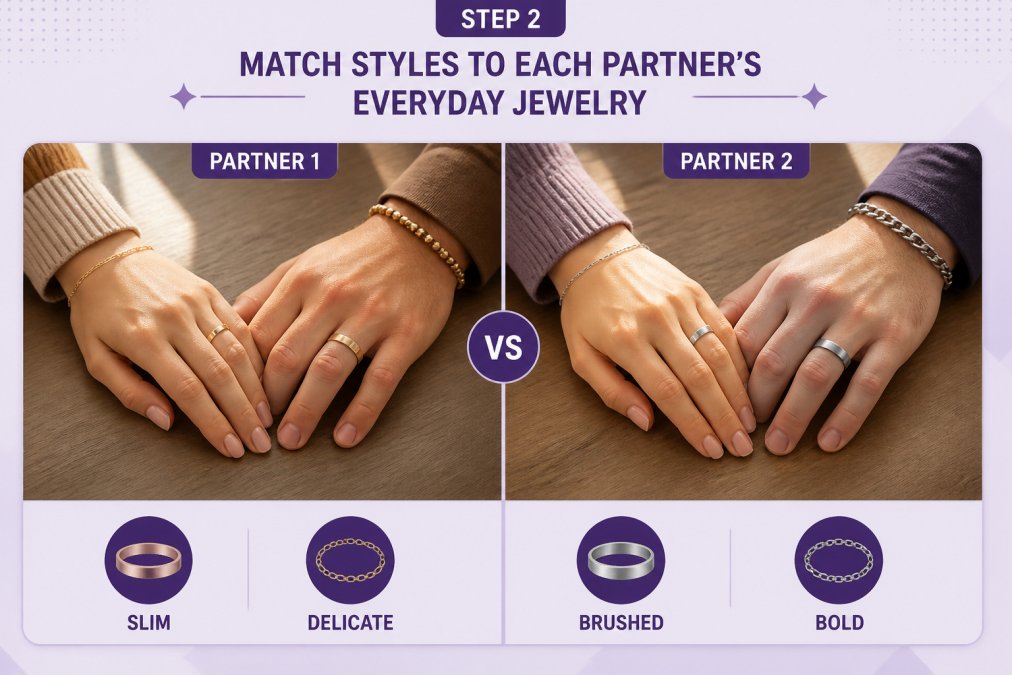
Here is a simple way to match styles:
- Note the metal color of existing jewelry. Warm yellow gold, rose gold, and silver tones rarely mix well in the same look.
- Check band width. Slim bands suit people who wear delicate chains. Wider bands suit bolder pieces.
- Consider how often the ring will be worn. A pick for daily wear should be low-profile and sturdy.
For example, a partner who wears a slim gold chain might prefer a thin band with a small engraved initial. A partner who favors chunky silver rings might want a wider band with a bold stone.
Step 3: Pick the Best Metals for Promise Rings
Metal affects how a ring looks, how it holds up, and whether it irritates skin. Compare options before you buy.
| Metal | Durability | Best For | Maintenance |
|---|---|---|---|
| Solid gold (14K) | High | Daily wear, long-term keepsake | Occasional polishing |
| Gold vermeil | Moderate | Budget-friendly look | Avoid water and lotion |
| Sterling silver | Moderate | Everyday styles, lower cost | Tarnishes; needs cleaning |
| Titanium | Very high | Active lifestyles | Minimal |
Solid gold tends to hold its value and resist wear. Compare gold vermeil and solid gold for custom promise rings Gold vermeil offers a similar look for less, but the gold layer can wear off over time.
Check for allergies before you buy. Nickel is a common irritant in cheaper jewelry, so look for nickel-free labels if either partner has sensitive skin.
Step 4: Get the Right Ring Size Guide for Both Partners
Sizing is where many promise-ring purchases go wrong, especially when one partner is buying in secret. A ring that is too tight is uncomfortable and hard to remove; one that is too loose slides off during everyday wear. The goal is a fit that clears the knuckle with slight resistance and sits snug at the base of the finger without pinching.
Start with the finger that will actually wear the ring
Promise rings are often worn on the right ring finger, but couples sometimes choose the left middle finger or another finger entirely. Confirm which finger each partner plans to use before you measure. A ring sized for the index finger will be too loose on the ring finger, and the difference is often a full size or more.
Measure an existing ring the right way
The most reliable method is to measure a ring the person already wears on the intended finger.
- Use a ring that fits well, not one that is already loose or tight.
- Measure the inside diameter in millimeters with a ruler or caliper, then compare it to a printable ring size chart.
- Measure at the end of the day. Fingers swell slightly with heat, activity, and salt intake, so a morning measurement can read a half size small.
A common pattern is for people to measure the outside of the ring by mistake. Always measure the inside opening, because band thickness varies and will throw off the reading.
Discreet sizing when the purchase is a surprise
If you cannot ask directly, borrow a ring the recipient wears on the same finger and trace its inside circle on paper, or press it into a soft bar of soap to capture the inner diameter. Return it to the exact spot so it is not missed. You can also ask a close friend, roommate, or family member who has shopped for rings with the recipient.
If you are planning a surprise, order a ring sizer gauge and leave it casually on a counter, or ask the recipient's friend to borrow a ring for an afternoon. Discreet beats guessing every time.
Account for band width and profile
Wider bands feel tighter than narrow ones because they cover more of the finger. As a rule of thumb, if the band is 6 mm or wider, many people go up a half size from their standard fit. Comfort-fit bands, which are rounded on the inside, also feel looser than flat-profile bands of the same size, so factor in the interior shape, not just the width.
Know the resizing limits before you buy
Not every ring can be resized. Sterling silver and gold bands can usually be adjusted by a jeweler, though repeated resizing weakens the metal. Titanium and tungsten are very difficult or impossible to resize, and rings with stones set around the full band, such as eternity styles, often cannot be resized without rebuilding the setting. If you are unsure of the size, choose a resizable metal or an open/adjustable design as a backup.
What to do if the fit is wrong
Check the return and exchange policy before you order, and confirm whether resizing is included. If the ring arrives too tight, do not force it; a jeweler can often stretch a plain band by a quarter to a half size. If it is too loose, sizing beads or a temporary ring guard can hold it in place until a permanent fix is made.
Never guess a size and hope for the best on a metal that cannot be resized. Titanium and tungsten rings that arrive the wrong size often cannot be fixed, and the cost falls on you.
Step 5: Set a Realistic Budget and Choose Gemstones
Budget is where promise-ring guides usually go quiet. A practical plan starts with a per-ring number, then works backward through the cost drivers: metal, stone, setting, engraving, and customization. Prices vary by retailer, so treat the ranges below as planning benchmarks and confirm current pricing before you commit.
What drives the cost
- Metal. Solid 14K gold is the biggest cost driver and typically runs several hundred dollars per ring for a simple band. Sterling silver and gold vermeil sit at the lower end, often under $150 for a plain design. Titanium is moderate and very durable.
- Stone. A lab-grown stone or a small natural gemstone adds cost, while a plain band keeps the budget focused on metal and engraving. Two-stone designs cost more than single-stone settings because of the extra setting work.
- Setting. Secure bezel settings cost more than simple prongs but protect the stone better for daily wear.
Set a per-ring budget first, then choose the metal and stone that fit inside it. A well-made silver or titanium band with a meaningful engraving often delivers more everyday value than a fragile stone set in a thin gold band.
Choose stones that survive daily wear
Gemstone hardness matters for a ring worn every day. On the Mohs scale, diamond and moissanite rank at the top, sapphire and ruby are close behind, and emerald and opal are softer and more prone to chipping. For a promise ring worn constantly, favor harder stones or a protected bezel setting. Birthstones add personal meaning, but check the hardness of the specific month's stone before committing to daily wear.
Consider ethical and lower-impact options
Ask about sourcing before you buy. Lab-grown diamonds and sapphires offer the same look with a known origin, recycled gold and silver reduce the demand for newly mined metal, and many jewelers now stock fair-mined or traceable stones. These choices often cost less than their mined equivalents and let you align the purchase with your values. Ask the seller directly where the metal and stones come from and whether documentation is available.
Keep the total in view
Add up both rings, engraving, sizing, and delivery before you decide. A pair that looks affordable per ring can climb quickly once customization and shipping are included. Confirm the return window and whether resizing is covered, then commit to a number you are both comfortable with.
Step 6: Plan How to Give a Promise Ring and Talk About It
The ring is only part of the gift. Explore meaningful anniversary gift ideas for parents How you present it and what you say matter just as much.
Watch out: if one partner expects a conversation about commitment and the other does not, the moment can feel awkward.
Some practical tips:
- Pick a private, relaxed setting where you can talk without rushing.
- Explain what the ring means to you in your own words.
- Give your partner space to respond. A promise ring is a conversation starter, not a demand.
We recommend agreeing on the meaning of the rings before the moment arrives. That way both of you can enjoy the gift without guessing what it signals.
Your Next Step: Shop Matching Sets With Gear Luxe Co
Now you know how to compare styles, metals, sizes, and budgets. The next step is finding rings that match what you decided.
Frequently Asked Questions
How do you choose matching promise rings?
Start by deciding whether you want identical bands or coordinated designs. Identical rings suit couples who like a symbol of sameness, while coordinated rings share one element, such as the same metal, band width, or a complementary motif, and still look like they belong together. Next, look at what each partner already wears. If one of you favors thin, minimalist pieces and the other prefers chunky styles, a coordinated pair often feels more personal than forcing one design on both. Confirm metal color and band width last, since those two details most affect how the rings look side by side.
Do matching promise rings have to look identical?
No. Matching promise rings can share a metal, a width, or a motif without being identical. Many couples choose a shared symbol, such as a small stone set in the same position or a matching engraving, and let the rest of the design reflect each person's taste. Identical bands are simple and clearly symbolic, while coordinated rings can feel more personal when partners have very different everyday jewelry styles. Either approach works as long as both rings feel like they were chosen together.
How do you find the right ring size for both partners?
If the purchase is a surprise, ask a close friend or check a ring they already wear on the same hand.
How do you give a promise ring?
Choose a moment without distractions, such as a quiet dinner or a walk you both enjoy. Say what the ring represents in your own words, whether that is a commitment to exclusivity, a promise to grow together, or a step before an engagement. Keep the conversation open afterward so your partner can share how they feel. If you are giving matching rings, you can put yours on together, which makes the moment feel shared and balanced.


