


Last Updated: October 28, 2026
Quick Summary
An eco friendly drinkware option is worth it if you will use the cup often, keep it long enough to outlast disposable cups, and actually wash and reuse it. Stainless steel and glass usually last longest, while bamboo and recycled-material options each carry trade-offs.
- Check how often you drink, how long the cup will last, and whether you will reuse it.
- Laser engraving on stainless steel or bamboo adds no ink layer and keeps the cup easier to recycle.
- Bamboo-fiber products should not be soaked or put in the dishwasher, so they suit lighter use.
- Ask suppliers for the material safety data sheet and resin identification code before ordering.
- Tell gift recipients whether the cup is hand wash only and how to separate parts for recycling.
Table of Contents
- Why Plastic Drinkware Is Worth Replacing
- Eco Friendly Alternatives to Plastic Custom Drinkware
- Stainless Steel Custom Tumblers: Durability and Insulation
- Glass Reusable Cups: Taste and Transparency
- Bamboo Drinkware: Natural Look and Its Limits
- Recycled Material Promotional Drinkware and Recyclability
- Choosing the Right Eco Friendly Mug for Your Next Gift
- Frequently Asked Questions
Why Plastic Drinkware Is Worth Replacing
Is an eco friendly drinkware option actually worth the switch from plastic? The answer depends on how you plan to use it.
Plastic cups are cheap to buy and easy to forget. Many people replace them often, which adds up to a steady stream of waste. Reusable drinkware changes that math, but only if you choose a material that lasts. A cup that cracks after a season does not reduce much of anything.
The fair question is whether the switch pays off for you personally. Check three things: how often you drink from the cup, how long you expect it to last, and whether you will actually wash and reuse it. If the answer to all three is yes, a durable custom piece usually beats buying disposable cups again and again.
Eco Friendly Alternatives to Plastic Custom Drinkware
The main alternatives fall into a few material groups: stainless steel, glass, bamboo-fiber composites, and recycled-content products. Each one trades something away. Stainless steel is tough but heavier. Glass tastes clean but breaks more easily. Bamboo looks natural but needs careful handling. Recycled-material options reduce virgin plastic use but do not always solve end-of-life disposal.
Before you buy, decide which trade-off you can live with. A camping mug and a desk mug have different jobs, and the right material follows from how you will use it.
What Most Guides Skip: The Customization Footprint
Most comparisons stop at the cup body, but for custom drinkware the branding method can matter as much as the material. Three common techniques carry very different environmental profiles:
- Screen printing: Uses plastisol or UV-cured inks and a separate screen per color. Durable and inexpensive at volume, but the inks are typically plastic-based and the screens require cleanup solvents. Best for large orders where the design is simple.
- Pad printing: Similar ink chemistry to screen printing but suited to curved surfaces like tumblers. The pad and cliché add consumables, and ink waste is common during setup.
- Laser engraving: Burns the design directly into the surface with no ink, no screens, and no solvents. On stainless steel and bamboo it produces a permanent mark that will not chip or peel. The trade-off is that it only works on certain materials and cannot reproduce full-color artwork.
- UV digital printing: Full-color and low-setup, but the cured ink layer can wear faster than engraving and is difficult to separate from the substrate at end of life.
If longevity is the goal, laser engraving on stainless steel or bamboo is usually the lowest-impact branding choice because it adds no ink layer and does not compromise recyclability. Ask your supplier which method they use before you assume a "green" cup has a green logo on it.
End-of-Life: What Actually Happens to Each Material
A cup is only as sustainable as its disposal path. Here is how the main materials typically behave:
- Stainless steel: Widely recyclable through curbside programs and scrap metal dealers. Remove plastic lids, straws, and silicone sleeves first, since mixed-material assemblies are often rejected.
- Glass: Infinitely recyclable in most curbside programs, but only if it is not tempered or mixed with a plastic lid. Broken glass should be wrapped and placed in the recycling bin only if your local program accepts it.
- Bamboo-fiber composites: Usually bound with a resin (often melamine or a plant-based binder). Most curbside programs will not accept them, and they are not accepted in municipal composting because of the binder. Treat them as landfill-bound unless the manufacturer offers a take-back program.
- Recycled-content plastic: Recyclability depends on the specific resin code and local acceptance. A cup made from recycled polypropylene may still be recyclable, but a multi-layer or composite cup often is not.
Durability and the Break-Even Point
A common pattern in lifecycle comparisons is that the production footprint of a reusable cup is paid back after a modest number of uses, often cited in the range of 20 to 100 uses depending on material and washing method. The exact number varies, but the implication is consistent: the cup only wins if it stays in service. That is why stainless steel and glass, which survive years of daily use, tend to outperform lightweight composites that crack or stain within a season. When comparing options, ask how many uses the cup is realistically expected to deliver, not just what it is made of.
A Quick Supplier Vetting Checklist
Supply chain transparency is where most buyers get burned. Before committing to a custom order, confirm:
- Where the raw material is sourced and whether recycled content is certified.
- Whether the factory holds a recognized social compliance audit.
- Which branding method is used and whether inks or solvents are involved.
- Whether the supplier offers replacement parts (lids, straws) so the cup does not become waste when one component fails.
- Whether the supplier will disclose the resin code or material composition in writing.
A supplier who can answer these questions is more likely to deliver a cup that lives up to its eco-friendly label.
The article compares the main branding methods for custom drinkware, each with a different environmental profile.
| Branding method | Ink or solvent use | Best fit |
|---|---|---|
| Screen printing | Plastisol or UV inks, solvent cleanup | Large orders with simple designs |
| Pad printing | Similar ink chemistry, ink waste at setup | Curved surfaces like tumblers |
| Laser engraving | No ink, no screens, no solvents | Stainless steel and bamboo, permanent marks |
| UV digital printing | Cured ink layer, hard to separate at end of life | Full-color artwork, low setup |
Stainless Steel Custom Tumblers: Durability and Insulation
Stainless steel is the most practical choice for people who travel, commute, or take a drink outdoors, and it is a strong pick among eco friendly drinkware. It resists drops far better than glass and does not carry the taste or odor issues some plastics develop. If you already own one, a guide to removing vinyl from stainless steel tumblers safely explains the methods to use.
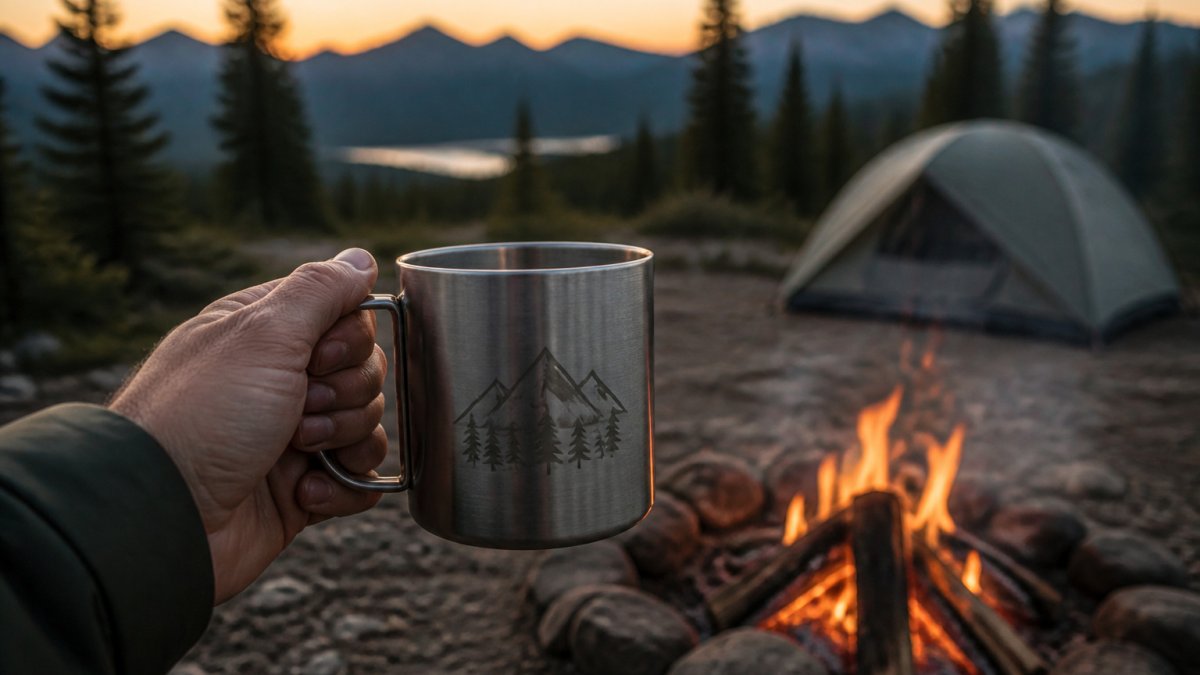
Our Fluffy Cows Camping Mug is a good example. It is a stainless steel mug with an enamel coating and a rounded steel rim, holding 12 fl oz. The enamel layer protects the surface and makes cleaning simple. Keep in mind that it is hand wash only and not microwave safe, so plan your cleaning routine accordingly. If durability of the printing is your priority, personalized tumblers designed so their printing does not peel are worth comparing.
Watch out: do not put a hot liquid into a metal cup and then cover the rim with a plastic lid rated for cold drinks only. Check the lid specification before you pair the two.
Glass Reusable Cups: Taste and Transparency
Glass is the easiest material to trust for taste. It does not absorb flavors, and you can see exactly what is inside. That makes glass a strong choice for tea, juice, and iced drinks you prefer to pour at home or the office.
The trade-off is weight and fragility. Glass breaks, so it suits a desk or kitchen better than a backpack. If you need something that survives a commute, stainless steel will serve you better.
Bamboo Drinkware: Natural Look and Its Limits
Bamboo drinkware appeals to buyers who want a warm, natural appearance. The material is renewable and looks distinctive on a shelf or table.
Its limits matter. Bamboo-fiber products generally should not be soaked, left in the dishwasher, or exposed to long periods of moisture, because the fibers can swell and degrade over time. Read the care instructions closely before buying, and treat bamboo as a lighter-duty option than steel.
Recycled Material Promotional Drinkware and Recyclability
Recycled-content drinkware reduces demand for virgin plastic, which is a real benefit. The catch is that a cup made partly from recycled material is not automatically recyclable at the end of its life. Recyclability depends on the material composition and on what your local facilities accept.
If end-of-life disposal matters to you, look for clear material labeling and check your local recycling rules before assuming a product can go in the bin. Many people find that the most sustainable cup is the one they keep using for years, regardless of its label.
Choosing the Right Eco Friendly Mug for Your Next Gift
Gifts are where durability matters most, because the recipient should still be using the item long after the occasion. Engraving that wears off or a coating that chips makes a personal gift feel disposable.
Gear Luxe Co products are built for daily use. Our Mama Bear and Dino Smores camping mugs use the same stainless steel and enamel construction as our other mugs, each priced at $20.95. For a practical gift, we recommend choosing the material that fits the recipient's routine:
- Commuters and outdoor users: stainless steel
- Desk and home drinkers who value taste: glass
- Gift buyers wanting a natural look: bamboo, with careful-care expectations set
Before ordering, confirm the care instructions and capacity, then pick the design that matches the person. A well-chosen custom mug used every day is hard to beat as an eco friendly option.
Matching the Branding Method to the Gift
The customization technique should follow the recipient and the occasion, not just the artwork:
- Corporate gifts at volume: laser engraving on stainless steel gives a permanent, ink-free mark that survives years of washing and looks premium. It is the safest choice when you cannot control how the recipient will care for the cup.
- Personal gifts with full-color art: UV digital printing reproduces photos and complex logos, but set expectations that the print may fade with heavy dishwashing. Pair it with a hand-wash card.
- Natural-look gifts: laser engraving on bamboo avoids adding an ink layer to a material that is already hard to recycle, keeping the end-of-life path as simple as possible.
Bulk Orders and Event Gifting
For weddings, conferences, and corporate events, the sustainability math shifts because volume amplifies both the benefit and the waste. A few practical rules:
- Order a realistic quantity. Leftover branded cups that go unused are waste regardless of material.
- Choose one durable material and one branding method across the order so care instructions stay simple for recipients.
- Include a small care card with each cup explaining hand-wash requirements and how to recycle the cup and its lid separately at end of life.
- Ask the supplier whether lids and straws are available as replacement parts, so a lost lid does not retire an otherwise good cup.
Setting Care Expectations Up Front
A gifted cup that gets ruined in the first dishwasher cycle becomes waste quickly. When you hand over a custom mug, tell the recipient three things: whether it is hand wash only, whether it is microwave safe, and how to separate components for recycling. That short conversation is the difference between a gift that lasts years and one that ends up in a drawer.
Frequently Asked Questions
What are the best eco-friendly alternatives to plastic drinkware?
The product catalog includes stainless steel camping mugs with enamel coating. The listed mugs have a 12 fl oz capacity, are hand wash only, and are not microwave safe.
Is stainless steel drinkware more sustainable than plastic?
Gear Luxe Co's stainless steel camping mugs with enamel coating have a 12 fl oz capacity, are hand wash only, and are not microwave safe.
Can reusable custom drinkware be recycled at the end of its life?
The product catalog lists stainless steel camping mugs with enamel coating, but does not specify their end-of-life recycling options. Check local recycling guidance for information about disposal.


