


Table of Contents
- Why Verifying American Made Labels Matters for Gift Givers
- Understanding the FTC Made in USA Standard
- Made in USA vs Assembled in USA: What's the Real Difference
- How to Spot Misleading Product Labels
- Questions to Ask Sellers About Product Origin
- Step-by-Step Verification Process for Gift Purchases
- Common Mistakes to Avoid When Verifying Origin Claims
- Frequently Asked Questions
Last Updated: October 20, 2026
Why Verifying American Made Labels Matters for Gift Givers
When you buy a personalized gift, you're making a promise: this came from somewhere real, made with care. But labels can lie, mislead, or hide the truth.
A gift labeled "American made" might have components sourced overseas; one claiming "assembled in the USA" might have arrived 95% finished from another country.
At Gear Luxe Co, we believe gift-givers deserve clarity. You're buying a story to tell the person you care about, and that story should be true.
Understanding the FTC Made in USA Standard
The Federal Trade Commission (FTC) enforces the rules for "Made in USA" claims under its Made in USA Labeling Rule and the FTC Act's prohibition on deceptive advertising.
The FTC recognizes two categories of claims: (the FTC)
Unqualified "Made in USA" claims. A product can carry an unqualified claim only if all or virtually all of it is made in the United States, meaning the final product and its components are made here and any foreign content is negligible (the FTC).
For gift buyers, a qualified claim is not a lie, but it is not the same as an unqualified "Made in USA" claim.
The FTC does not pre-approve claims or require proof before a company uses a "Made in USA" label; enforcement generally follows consumer complaints or the FTC's own monitoring. The burden of scrutiny falls on buyers.
Legitimate manufacturers state the claim precisely and back it with documentation on request. Misleading sellers use "Made in USA" prominently while qualifying it in tiny text or omitting the qualification entirely.
Made in USA vs Assembled in USA: What's the Real Difference
These two phrases sound similar but are not the same.
Made in USA means the product was substantially made here. Raw materials were sourced, processed, assembled, and finished in the United States.
Assembled in USA means the final assembly step happened here. But the parts? They could come from anywhere.
For gift-givers, the distinction is important.
Most personalized gifts fall into the "assembled" category.
How to Spot Misleading Product Labels
Misleading labels use vague language, qualified claims, or strategically placed text. A label might say "Made in USA" in huge letters while tiny text says "except for imported components." That's technically honest but designed to deceive.
Check for Vague Language and Qualified Claims
The FTC allows "qualified" claims, meaning a company can say "Made in USA" as long as it explains what that means. But the explanation can be tiny, unclear, or hidden.
Watch for these red flags:
- "Made in USA with imported parts", This is a qualified claim. It's allowed, but it tells you exactly what you need to know: parts came from overseas.
- "Proudly made in the USA", The word "proudly" is filler. It doesn't change the legal requirement. But it's often used to distract from a qualified claim elsewhere.
- "American assembled", This is the phrase that separates American assembly from American manufacturing. It's not the same.
- "Designed in USA", Design happens on a computer. Manufacturing happens in a factory. These are different things.
- "Distributed by [USA company]", Distribution is not manufacturing. This claim tells you nothing about where the product was made.
The pattern is clear: the vaguer the language, the more you need to dig.
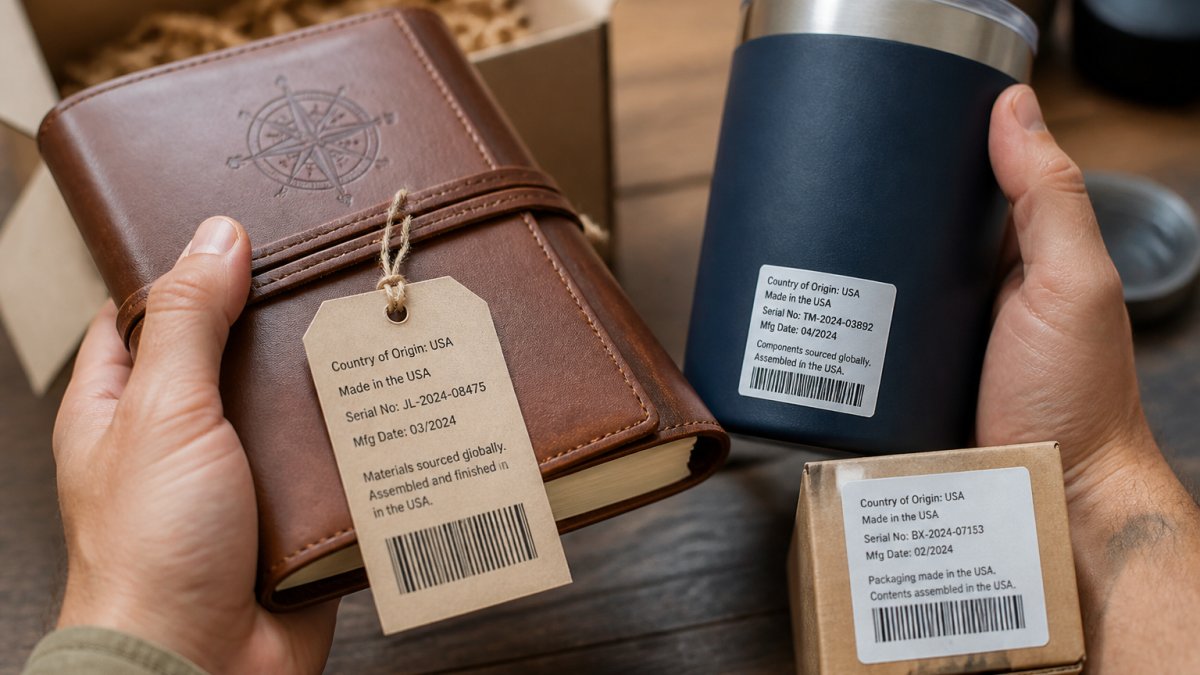
Inspect Packaging, Fonts, and Design Details
Counterfeit and misleading products often have sloppy details, though even legitimate products sometimes cut corners on packaging.
Look for these inconsistencies:
- Spelling and grammar errors on labels, tags, or packaging
- Mismatched fonts or inconsistent sizing (a sign of rushed production)
- Blurry or pixelated text on labels (especially country-of-origin information)
- Inconsistent logo design compared to the brand's official website
- Cheap or flimsy packaging that doesn't match the product quality
These aren't always proof of a problem, but they're signals to investigate further. A luxury personalized gift should have professional packaging.
Questions to Ask Sellers About Product Origin
Gift buyers face a constraint most verification guides ignore: a deadline.
Before you contact a seller, gather what you can from the listing: country-of-origin statements, material disclosures, and contact information.
When you contact the seller, ask these questions in writing so you have a record:
-
"Where is the product manufactured, and where are its components made?" Listen for a specific location and a distinction between final assembly and component manufacturing. A seller who says "made in the USA" without addressing components may be making an unqualified claim that does not hold up.
-
"Is your 'Made in USA' claim unqualified or qualified?" A knowledgeable seller will understand the difference and answer directly. A seller who does not recognize the question may not have examined their own claim.
-
"Can you provide documentation that supports the claim, such as a certificate of origin, supplier statements, or a supply-chain disclosure?" Legitimate manufacturers often have paperwork and are willing to share it. A seller who cannot provide any documentation is asking you to take the claim on faith.
-
"Which parts or materials are imported, and what percentage of the product is domestic?" This question surfaces qualified claims that may not be obvious from the listing. If the seller cannot answer, the claim is unverified.
-
"Has a third party verified your origin claim?" Some manufacturers work with independent verification organizations. A verifiable third-party review is stronger evidence than a self-asserted claim.
-
"If I order today, will the product arrive by my gift deadline, and does the packaging include country-of-origin information?" Gift-specific timing and packaging details matter. A seller who cannot confirm delivery or describe the packaging may be reselling rather than manufacturing.
Pay attention to how the seller responds, not just what they say. A confident, specific answer addressing components, documentation, and timing is a good sign. Vague language ("overseas," "various facilities," "global supply chain"), delays, or defensiveness are signals to buy elsewhere.
For gift buyers, the goal is not to interrogate every seller but to request the specific evidence that matches the claim. An unqualified "Made in USA" claim should be backed by documentation showing domestic components and assembly; a qualified claim should be stated clearly and consistently across the listing, packaging, and seller communications. When those elements line up, you have reasonable confidence to buy.
Step-by-Step Verification Process for Gift Purchases
Follow this process before you buy. It takes 10 minutes and protects you from misleading claims.
Step 1: Locate and Read the Country-of-Origin Label
Find the label (on a tag, packaging, or inside a box) and read it carefully. Look for:
- The country name (should say "USA" or "United States")
- Any qualified claims (like "except for imported components")
- Manufacturing date or batch code
- Manufacturer name and location
If the label is hard to read, unclear, or missing entirely, that's a warning. Legitimate products have clear labeling.
Step 2: Cross-Check Serial Numbers and Date Codes
Many personalized items have serial numbers or date codes that trace the product back to its manufacturing facility. If the product has a code:
- Write it down
- Search for it on the manufacturer's website
- Contact the manufacturer directly and ask what facility produced that item
Date codes tell you when the product was made. If a "handmade" item's date code shows mass production timing, something's off.
Step 3: Research the Seller and Manufacturer
Google the company name. Look for:
- How long they've been in business
- Customer reviews (especially complaints about origin claims)
- Their physical address (a real business has a real location)
- Whether they have a verifiable manufacturing facility
A company with a physical address, business registration, and years of history is more trustworthy than a nameless online seller.
Step 4: Assess Materials and Workmanship Quality
Hold the product and examine it closely. Ask yourself:
- Does the material feel high-quality?
- Are the seams straight and even?
- Is the engraving or personalization crisp and clear?
- Are there rough edges, loose threads, or obvious defects?
Cheap materials, poor craftsmanship, and visible defects suggest corners were cut, possibly including truthfulness about where it was made.
Step 5: Request Documentation or Certificates
Ask the seller for proof. Legitimate manufacturers often have:
- Certificates of origin from customs
- Third-party verification documents
- Supply chain transparency reports
- Manufacturing facility certifications
If the seller can't provide these, it doesn't automatically mean the product is fake, but you can't verify their claim. Buy at your own risk.
Common Mistakes to Avoid When Verifying Origin Claims
Avoid these common mistakes.
Trusting the label without verification. Labels can be wrong, mistaken, or dishonest.
Assuming "handmade" means "American made." These are different claims. A product can be handmade in any country.
Ignoring red flags in packaging or communication. Sloppy labels, spelling errors, evasive answers, these are signals. Trust them.
Confusing "assembled" with "made." They're not the same. Know which one you're actually buying.
Paying a premium for an "American made" claim without verifying it. You're paying extra. Verify before you pay.
At Gear Luxe Co, we believe transparency matters. Our personalized gifts are primarily assembled and shipped from our small business factory in the USA.
Verifying American made labels for gifts protects your money and your integrity. Every piece comes with our 100% satisfaction guarantee. Learn more about Made in USA standards from the Federal Trade Commission to understand your rights as a buyer.
Frequently Asked Questions
What does the FTC say a product must be to qualify as Made in USA?
According to FTC standards, a product can be called 'Made in USA' only if it is wholly or substantially made in the United States. All significant parts and processing must originate here, and any foreign content must be insignificant. 'Assembled in USA' has a different meaning, it indicates assembly happened here, but components may come from elsewhere. When you verify American made labels for gifts, check which claim the label actually makes, as they carry different legal weight.
How can I tell if a gift labeled 'Made in USA' is actually made here or just assembled here?
Look for the exact wording on the label. 'Made in USA' means substantial domestic production; 'Assembled in USA' means only final assembly occurred domestically. Ask the seller directly: where are the components sourced, and what percentage of the product's value comes from domestic work? Small businesses often provide detailed answers. Check the product listing for manufacturing details, and request documentation if the claim seems central to your purchase decision.
What questions should I ask a seller to verify a product's origin before buying a gift?
Ask: Where is the product manufactured or assembled? Are components sourced domestically or internationally? How long has the seller been in business, and can they provide references or certifications? For personalized items, ask if customization happens domestically. Legitimate sellers answer these questions directly and may offer documentation. If a seller is evasive or provides vague responses, that's a red flag worth investigating further before purchase.
How do I spot a misleading 'American made' label on a gift product?
Watch for vague language like 'Made with pride' or 'Inspired by American values', these avoid making a direct origin claim. Check for spelling errors, poor font quality, or inconsistent design, which can indicate counterfeit or low-quality labeling. Look at the label's placement and permanence; authentic labels are securely attached. Compare the label against photos on the seller's official website. If materials feel cheap or the engraving/customization work appears rushed, the origin claim may be misleading. Trust your instinct, quality products typically show quality in every detail.


