


Table of Contents
- The Real Value of Small Business Gifts
- Benefits of Shopping Small: Economic and Community Impact
- Sustainability and Ethical Consumption in Gift-Giving
- How to Find High-Quality Small Business Gifts
- Corporate Gifting Best Practices for Small Vendors
- Logistics, Shipping, and Return Policies to Know
- Conclusion: Making Meaningful Choices with Small Business Gifts
- Frequently Asked Questions
Last Updated: September 11, 2026
The Real Value of Small Business Gifts
Why choose small business gifts? Because they carry what mass-produced items cannot: a story, a maker, and a personal touch the recipient remembers. This guide from Gear Luxe Co makes the practical and emotional case for shopping small in 2026.
A common frustration with big-box gifting is sameness: the same candle, mug, or boxed set on every shelf. Small-batch production changes that. Limited runs drop the odds of duplication sharply, so the gift feels chosen rather than grabbed.
That distinction matters more than most shoppers realize. According to consumer spending research from the Bureau of Labor Statistics, where households direct their dollars shapes which businesses survive in a community. Below, we break down the economic case, the sustainability angle, and the practical steps for vetting makers, timing shipments, and handling returns.
Uniqueness and Personalization You Can't Find in Big Box Stores
Small business gifts win on personalization because independent designers build customization into the product itself, not as an afterthought. A name necklace, a monogrammed journal, a bespoke tumbler: these are one-of-a-kind by design, not by accident.

Mass-market retailers optimize for volume: standard sizes, fonts, and packaging. An artisan working in small batches can adjust the details, font choice, finish, engraving depth, gift note, because you are buying from the person who makes the item.
Personalization also solves the recipient who "has everything": a custom piece tied to a name, date, or shared memory sidesteps the generic gift trap.
Benefits of Shopping Small: Economic and Community Impact
The benefits of shopping small extend beyond the transaction. Independent businesses recirculate revenue locally, hire locally, and sponsor the events and teams that hold a community together, so a meaningful share of your handcrafted gift purchase stays close to home.
Consider how a dollar moves. A large retailer routes profit to shareholders and distant supply chains; a small operation pays its own staff, local suppliers, and often its neighbors. That is purchasing power with a visible destination.
Community support is not just sentiment. Small-scale manufacturing keeps specialized skills alive: leatherwork, engraving, jewelry finishing. Every order is a small vote for that craft continuing to exist.
Sustainability and Ethical Consumption in Gift-Giving
Sustainability in gifting comes down to three levers: how much is produced, how far an item travels, and how long the recipient keeps it. Small-batch production attacks the first, inventory never made cannot become landfill. Domestic assembly attacks the second. Durability attacks the third, usually the biggest.
Why the footprint comparison favors small vendors (with caveats)
Most guides wave at "lower emissions" without explaining the mechanism: transportation emissions scale with distance and weight, and mass retail depends on long, multi-leg supply chains, raw material to overseas factory, factory to port, port to distribution center, center to store, store to buyer. A domestic maker compresses that to one or two legs.
That said, small does not automatically mean greener. Three variables decide it:
- Batch size vs. demand. A maker producing to order generates almost no dead inventory. A maker producing a large speculative batch and discounting the leftovers has the same overproduction problem as a big-box brand, just at smaller scale.
- Material sourcing. Domestic assembly with imported components still carries their embedded transport footprint. Ask where the leather, metal, wood, or clay originates, not just where the item is finished.
- Packaging. This is where small vendors often lose: an artisan shipping in a rigid box with tissue, filler, and a plastic sleeve can produce more packaging waste per unit than a retailer using a right-sized corrugated mailer. Ask what the item ships in.
A practical framework for judging a gift's footprint
Rather than trusting a "sustainable" label, run four questions against any gift:
- Is it made to order or made in bulk? Made-to-order wins on waste.
- Where does it ship from, and where did the materials come from? Domestic finishing plus domestic materials is the strongest combination; domestic finishing plus imported materials is a partial win.
- What is the expected lifespan? A leather journal or solid-metal piece that lasts a decade beats a trendy item replaced every year, regardless of where either was made (the EPA).
- What does the packaging look like? Recyclable paper and right-sized mailers beat plastic-heavy presentation boxes.
Ethical consumption is about transparency, not slogans
The ethical case for small vendors is not that they are automatically virtuous, it is that they are legible. A maker who knows their materials can name the tannery, mill, or supplier, and that traceability lets you make a real ethical judgment instead of accepting a marketing claim. Where a large supply chain obscures labor and sourcing behind subcontracting, a small operation puts the maker in direct contact with the buyer.
That direct line is the practical payoff: ask about labor practices, material origin, and end-of-life disposal and get an actual answer. Ethical consumption at this scale is a conversation, not a certification.
How to Find High-Quality Small Business Gifts
Finding high-quality small business gifts starts where makers actually sell: craft marketplaces, local markets, and independent brands' own storefronts. Vetting matters more than the platform.
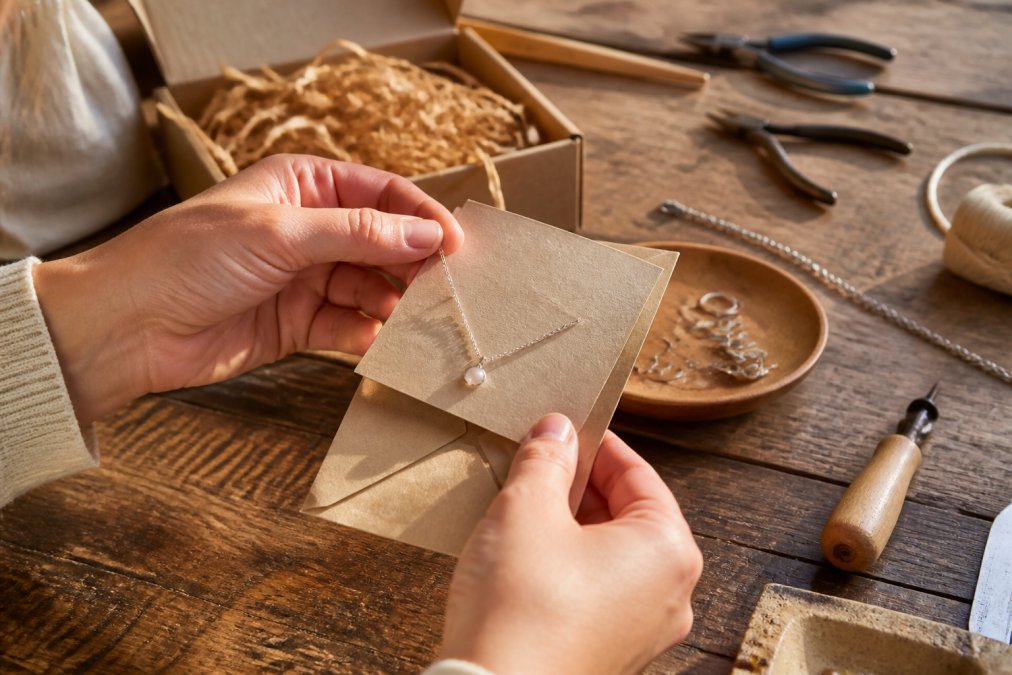
Start with the photography and description. A serious maker shows real photos of finished work and names materials precisely; vague listings with stock images are a warning sign.
Vetting Makers and Verifying Authenticity
Verifying authenticity is the step most buyers skip, and it prevents disappointment. A few checks separate a genuine small operation from a reseller:
- Does the shop show work-in-progress photos or a workshop behind the scenes?
- Are materials named specifically, or described only in vague terms?
- Do reviews mention repeat purchases and specific product details?
- Is there a clear, written return and correction policy?
- Can the maker answer a technical question about how the item is finished?
- Does the listing avoid claiming "made in the USA" without any supporting detail?
A maker who passes these checks usually answers within a day and welcomes questions. The ones who dodge are telling you something.
Corporate Gifting Best Practices for Small Vendors
Corporate gifting through small vendors is a different procurement exercise than a big-box account. The trade-offs are real, limited capacity, longer lead times, fewer payment options, but so is the payoff in recipient perception and the story of where your dollars went. Plan around the constraints instead of discovering them mid-order.
The procurement realities nobody warns you about
Before you commit to a small vendor for a company order, confirm these five things in writing:
- Minimum order quantities (MOQs). Many independent makers set an MOQ per design, per size, or per color. A run of 25 units may be fine; a run of 25 units in five different colorways may not be, because each variation resets the setup.
- Production lead time, not shipping lead time. "Ships in 3 days" may mean 3 days after a 10-day production window. Ask for total time from order confirmation to delivery.
- Payment terms. Small vendors often require full payment upfront or a deposit, and may not accept purchase orders or net-30 terms. Budget accordingly and get the invoice format you need for your accounting system.
- Peak-season capacity. Q4 capacity at a small shop can be booked by early fall. For holiday orders, lock it in months ahead, not weeks.
- Single point of contact. The person answering your email is often the person making the item, an advantage for accuracy, a risk if they get sick or backlogged. Ask who covers.
A workable corporate order timeline
Working backward from a delivery date is the only reliable way to run a small-vendor corporate order:
- Confirm the recipient list and personalization spec first. Names, spellings, titles, and logo placement should be locked in a single approved document, not scattered across email threads.
- Approve a physical sample. For any run above a handful of units, a sample protects both sides. Budget the sample cost and the extra week it adds.
- Place the full order with a written production window. Get the confirmation in writing, including the ship date, not just the order date.
- Consolidate shipping. One bulk shipment to your office, which you then distribute, is usually cheaper and easier to track than individual drop-ships to recipients.
- Build in a buffer. Add at least a week beyond the quoted delivery date for holiday orders. Small-batch production is less predictable than warehouse fulfillment.
Vetting a small vendor for a company order
Corporate orders carry reputational risk that personal gifts do not: if the item arrives wrong, your company's name is on it. Run the same authenticity checks you would for a personal purchase, plus a few that matter at scale:
- Can the vendor provide references from other corporate clients?
- Is there a written policy for defects, misprints, or shipping damage across a bulk order?
- Will they sign a simple order confirmation specifying quantities, personalization, and dates?
- Do they carry liability insurance or provide any written guarantee for business orders?
- Can they handle a reorder later if you need to add recipients?
Corporate social responsibility as a real story, not a slogan
The CSR angle is strongest when specific. "This gift was made by a named independent maker, in a small batch, with materials sourced domestically" is a defensible story; "we support small business" without details is a slogan. The difference is whether you can answer follow-up questions, and with a small vendor, the maker is one email away.
That traceability is practical too: if a recipient asks where their gift came from, you have a real answer, the detail that makes a corporate gift memorable rather than disposable.
Logistics, Shipping, and Return Policies to Know
Shipping and returns are where small-vendor gifting most often goes sideways, so set expectations before ordering. Independent makers frequently produce to order, meaning longer lead times than a same-day warehouse.
Ask three questions before checkout:
| Question | Why It Matters | What a Good Answer Looks Like |
|---|---|---|
| Is this in stock or made to order? | Determines lead time | Clear production window stated upfront |
| How is it shipped, and how fast? | Affects arrival date | Named carrier with tracking included |
| What is the return and correction policy? | Protects your money | Written policy covering defects and errors |
If you need a gift by a specific date, say so before ordering and get confirmation. Ready-to-ship domestic items often arrive quickly, but made-to-order personalization adds production time, and "ready-to-ship" does not mean the same thing at every shop.
Returns on personalized items are usually more restrictive, which is fair: a name necklace cannot be resold. That is why you confirm spelling and details before production and choose a vendor with a clear correction policy for their own errors.
Conclusion: Making Meaningful Choices with Small Business Gifts
The case for small business gifts rests on three things: uniqueness mass production cannot match, economic impact that stays in the community, and a shorter, more transparent supply chain. The trade-off is planning, ordering earlier, confirming details in writing, and asking questions a big-box checkout never prompts.
At Gear Luxe Co, that trade-off is the whole point. Our personalized jewelry, leather journals, and custom accessories are primarily assembled and shipped from a small business factory, designed with love and care and backed by a 100% customer satisfaction guarantee. If you want a gift with a story behind it, browse our collection and find something made to be kept.
Federal Trade Commission guidance on "Made in USA" claims
Frequently Asked Questions
What are the benefits of buying gifts from small businesses?
Buying from small businesses keeps more money in the local economy, supports job creation, and often results in unique, handcrafted items you won't find in big box stores. Small business gifts frequently offer better personalization and higher quality because makers pay closer attention to detail. You also build a relationship with the seller, which means better customer service if something goes wrong with your order.
How can I verify the quality of gifts from small businesses?
Ask the seller directly about materials, production methods, and where items are assembled. Look for detailed product photos, customer reviews, and a clear return policy. For personalized pieces like engraved jewelry or custom tumblers, request information on how the engraving is done and whether it's guaranteed to last. A reputable small business will answer these questions without hesitation and may offer a satisfaction guarantee.
Are small business gifts more sustainable than mass-produced items?
Often, yes. Small-batch production uses fewer resources and creates less waste than large-scale manufacturing. Many small businesses source materials locally, which shortens the supply chain and reduces shipping emissions. Handcrafted items also tend to be higher quality, meaning they last longer and are less likely to end up in a landfill. Choosing a small business gift is a form of conscious consumerism that supports ethical consumption.
What is the etiquette for corporate gift-giving with small vendors?
Keep corporate gifts thoughtful but professional. Choose items that reflect your company's values, such as personalized leather journals or custom tumblers from a small business. Avoid overly expensive gifts that could be seen as inappropriate. Include a handwritten note to add a personal touch. Always check your company's gift policy and the recipient's workplace rules before sending anything, and consider timing around holidays or project milestones.
Finding a gift that feels personal takes more effort than adding a generic item to a cart. Gear Luxe Co makes that effort worthwhile with personalized jewelry assembled and shipped domestically, a 100% customer satisfaction guarantee, and pieces designed with love and care for the people who matter most. Get started with Gear Luxe Co and give a gift your recipient will actually keep.


