


Table of Contents
- Is Buying Custom Watches Online Safe? The Real Risks
- How to Spot a Fake Watch Website Before You Buy
-
Verification Checklist: Technical Signs of a Legitimate Seller
- Step 1: Check Domain Age and Registration History
- Step 2: Verify SSL Certificate and HTTPS Security
- Step 3: Cross-Reference Business Registration
- Step 4: Verify Physical Address on Google Maps
- Step 5: Check Third-Party Review Platforms
- Step 6: Examine Return and Warranty Policies in Writing
- Quick Verification Checklist
- Buyer Protection: Secure Payment Methods and Escrow Options
- Custom Watch Return Policy Explained
- Aftermarket Parts and Resale Value: What You Need to Know
- Serviceability and Warranty Coverage for Custom Watches
- Frequently Asked Questions
Last Updated: September 20, 2026
Is Buying Custom Watches Online Safe? The Real Risks
Buying custom watches online safe depends on knowing the real risks, but they're manageable with the right precautions. The biggest danger isn't the customization itself, it's the seller. Counterfeit watches flood online marketplaces, and scammers exploit the custom watch market because buyers can't inspect items before purchase.

How to Spot a Fake Watch Website Before You Buy
Fake watch websites show obvious design flaws, inconsistent branding, and poor grammar. Scammers move fast and cut corners.
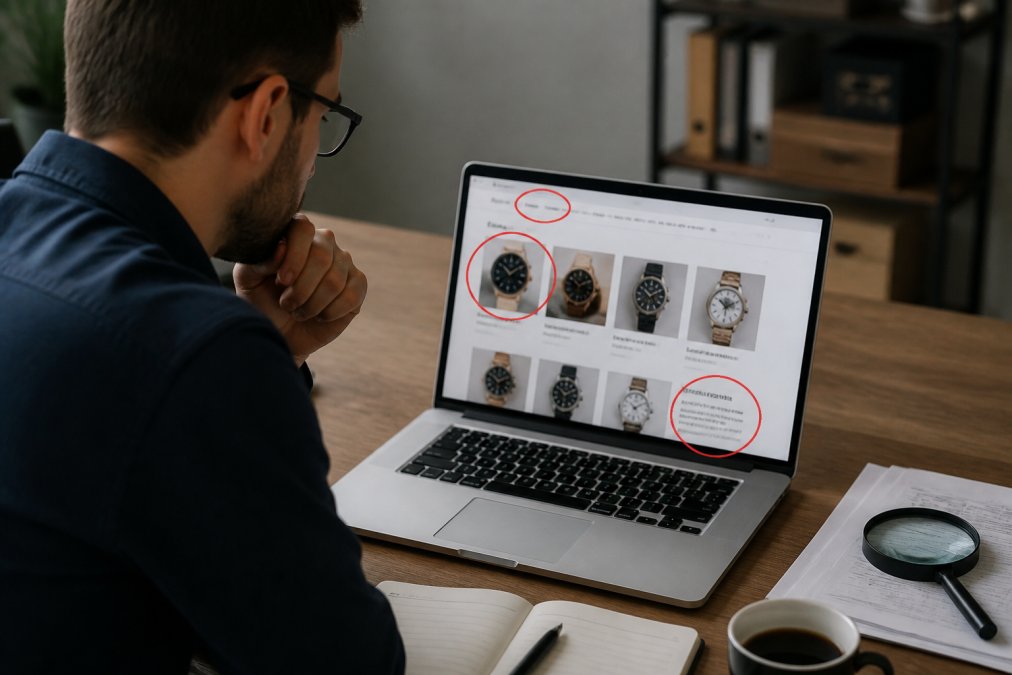
Look for these red flags immediately:
- Spelling and grammar errors in product descriptions or checkout pages
- Blurry or stolen product photos (reverse image search them, if they appear on multiple unrelated sites, the seller is lying)
- No physical address or only a P.O. box listed
- Vague "About Us" section with no real company history or team information
- Missing contact methods or only a contact form with no phone number
- Prices far below market rate for authentic custom watches
- No security badge (look for HTTPS, trust seals, or verified payment processors)
Verification Checklist: Technical Signs of a Legitimate Seller
A legitimate watch seller can prove their authenticity through specific technical markers. Don't skip this step.
Step 1: Check Domain Age and Registration History
Use WHOIS.net to check when the domain was registered. Look for domains 2+ years old with a business name (not personal name or privacy service). Domains registered within 6 months, especially watch-related ones mimicking known brands, are red flags.
Step 2: Verify SSL Certificate and HTTPS Security
Click the padlock icon next to the URL. The certificate should be issued to the business name, not expired, and from a recognized provider (DigiCert, Let's Encrypt, Sectigo, Comodo). OV or EV certificates are stronger than basic DV. Red flags: self-signed, expired, or generic domain certificates.
Step 3: Cross-Reference Business Registration
Search your state's Secretary of State database for the business name. It should appear as active, filed before the website launch. Red flag: no registration found or filed within weeks of launch.
Step 4: Verify Physical Address on Google Maps
Search the physical address on Google Maps. It should be a real location with business photos or reviews. Call the phone number to confirm someone answers. Red flags: P.O. box only, residential address for a claimed commercial business, or nonexistent address.
Step 5: Check Third-Party Review Platforms
Search BBB, Trustpilot, and Google Reviews for the seller. Reviews should include specific details and show patterns. Legitimate sellers respond to complaints. Red flags: no reviews, perfect 5-star ratings with generic praise, or multiple 1-star reviews citing non-delivery or counterfeits.
Step 6: Examine Return and Warranty Policies in Writing
The return policy should be easy to find with a 30+ day window, clear condition requirements, 1-year movement warranty, and specified refund timeline. Red flags: "no returns on custom items," vague terms, or no written policy.
Quick Verification Checklist
| Verification Point | How to Check | Pass Criteria | Red Flag |
|---|---|---|---|
| Domain age | WHOIS lookup | 2+ years old | Less than 6 months old |
| SSL certificate | Click padlock icon | OV or EV, not expired | Self-signed or expired |
| Business registration | State Secretary of State database | Active status, filed before website launch | No registration found |
| Physical address | Google Maps search + phone call | Real location, business answers | P.O. box only or nonexistent |
| Third-party reviews | BBB, Trustpilot, Google Reviews | Detailed reviews, responsive seller | No reviews or all perfect 5-stars |
| Return policy | Website footer or "About" section | 30+ days, clear terms | "No returns" or vague |
| Warranty | Product page or FAQ | 1+ year on movement | No warranty mentioned |
Don't rush this process. Spend 15-20 minutes verifying a seller before placing an order. If any red flags appear, move to the next seller. Legitimate businesses expect verification and have nothing to hide.
Buyer Protection: Secure Payment Methods and Escrow Options
Avoid debit cards, fraud protection is weaker and you lose access to your money during disputes.
Custom Watch Return Policy Explained
Legitimate sellers offer 30-60 day returns. The policy should specify the return window, condition requirements, who pays return shipping, and refund timeline.
Aftermarket Parts and Resale Value: What You Need to Know
Aftermarket parts reduce resale value. Watches with original components command 20-40% more than modified versions. Quality parts from reputable makers preserve value better than cheap replacements. Conservative modifications (new strap, engraving) won't hurt value; replacing the movement or case will. The pre-owned market for custom watches is smaller, meaning slower sales and lower prices. Proprietary parts that no watchmaker will service create expensive repair problems for future owners.
Serviceability and Warranty Coverage for Custom Watches
A custom watch is only as good as the person who can fix it later. Serviceability determines whether your watch remains usable or becomes a paperweight.
Why Serviceability Matters for Custom Watches
Proprietary parts or non-standard movements lock you into the seller's service center. Standard movements (ETA, Seagull, Miyota, Ronda) are used across thousands of models, parts are available and repair costs predictable. Proprietary movements create dependency; if the seller closes, you have no service options.
Men Silver Stainless Steel Waterproof →
Understanding Movement Types and Serviceability
Standard movements (ETA, Miyota, Seagull, Ronda) are documented, widely serviceable, and cost $50-$200 to repair. Semi-proprietary movements (in-house or modified designs) require specialized knowledge and cost $300-$500 to repair. Fully proprietary movements are nearly impossible to service outside the original builder, avoid unless the seller guarantees lifetime service.
Questions to Ask Before Ordering
Contact the seller directly and ask these specific questions:
-
"What movement does this watch use? Is it a standard movement (like ETA, Miyota, Seagull) or a custom/proprietary movement?"
- If they can't name the movement clearly, that's a red flag.
-
"Can a standard watchmaker service this watch, or do I need to send it back to you for service?"
- Their answer reveals whether they built for durability or dependence.
- If they say "only we can service it," ask why.
-
"How long do you plan to offer service for this watch model? What happens if your business closes?"
- Legitimate sellers have a service plan. Evasive answers are a warning sign.
-
"Are replacement parts available if the crystal cracks or the strap breaks? Where would I source them?"
- Standard parts (sapphire crystals, common straps) should be easy to replace.
- Proprietary parts create long-term costs.
-
"Do you provide a service manual or documentation for this watch?"
- Transparency about the watch's design suggests confidence in serviceability.
Warranty Coverage: What's Actually Protected
Read the warranty carefully. Most custom watch warranties cover the movement (internal mechanism) for 1-2 years. This covers manufacturing defects like misaligned gears, faulty springs, or poor assembly.
What warranties typically cover:
- Movement defects (gears, springs, escapement)
- Water resistance failure (if the watch is sealed improperly)
- Crystal defects (cracks from manufacturing, not impact)
What warranties typically exclude:
- Damage from drops, impacts, or accidents
- Water damage from submersion beyond rated depth
- Wear and tear on straps or bands
- Damage from improper storage or handling
- Modifications made after purchase
Red flags in warranty terms:
- "1-year warranty on movement only" (doesn't cover crystal, case, or strap issues)
- "Warranty void if opened by anyone other than us" (locks you into their service)
- "No warranty on custom modifications" (suggests they're not confident in their work)
- "Warranty does not cover water damage" (on a watch marketed as waterproof)
Evaluating Long-Term Service Costs
Before customizing, estimate the total cost of ownership over 5-10 years:
- Annual service cost: A standard movement costs $50-$150 per service (every 3-5 years). A proprietary movement costs $300-$500 or more.
- Parts availability: Standard parts cost $10-$50. Proprietary parts cost $50-$200 or may be unavailable.
- Travel time: If you must mail the watch to the seller for service, factor in shipping costs ($15-$30 each way) and turnaround time (2-4 weeks).
Red Flags for Serviceability
- Seller refuses to name the movement or claims it's "custom-designed"
- Seller insists you can only service it through them
- Seller has no documented service history or customer testimonials about service
- Seller's website has no FAQ or documentation about long-term care
- Seller is a new business with no track record of supporting older watches
- Warranty explicitly voids if you take the watch to another watchmaker
Green Flags for Serviceability
- Seller clearly identifies the movement (e.g., "Miyota OS20 automatic")
- Seller provides a service manual or documentation
- Seller confirms that standard watchmakers can service the watch
- Seller offers service at a transparent, published price
- Seller has customer reviews mentioning successful service experiences
- Seller's warranty allows third-party service without voiding coverage
- Seller has been in business for 5+ years and has a service track record
Frequently Asked Questions
What payment methods offer the most protection when buying custom watches online?
Credit cards and PayPal provide strong buyer protection through chargeback rights if the seller fails to deliver or sends counterfeit goods. Escrow services act as neutral third parties, holding your payment until you verify authenticity and condition. Avoid wire transfers and cryptocurrency, these offer no recourse if something goes wrong. Always use secure payment gateways (look for HTTPS and a padlock icon) and never send money through untraceable methods.
How can I verify the quality of parts used in a custom watch?
Ask the seller for detailed specifications of aftermarket parts, including movement caliber, bezel material, and dial customization details. Request photos of the movement and internal components. Legitimate watchmakers provide certificates of authenticity for high-quality components. Check if the seller offers warranty coverage on parts, reputable sellers stand behind their work. Cross-reference part names with horology forums to confirm they're genuine, not counterfeit components.
Does a custom watch void the original manufacturer's warranty?
Yes, most manufacturer warranties become void when you modify the watch with aftermarket parts. Custom modifications, including dial changes, case alterations, and movement upgrades, fall outside the original warranty terms. However, reputable custom watchmakers provide their own warranty coverage on the work they perform. Always ask about the seller's warranty before purchasing and get it in writing. This protects you if aftermarket components fail within a specified timeframe.
What are the risks of buying custom watches from social media marketplaces?
Social media platforms offer limited transaction security and buyer protection compared to established e-commerce sites. Scammers exploit these channels because verification is minimal and accounts can disappear quickly. Counterfeit watches are common, and return policies are often unclear or unenforced. Always request detailed photos, movement verification, and proof of authenticity before committing. Use secure payment methods with buyer protection, and avoid sellers with limited history or feedback. Trusted sellers typically have established websites outside social media.


