


Table of Contents
- Step 1: Recognize the Most Common Online Gift Scams
- Step 2: How to Spot a Fake Online Store Before You Buy
- Step 3: Inspect Physical Gift Cards for Tampering
- Step 4: Choose Secure Payment Methods for Online Shopping
- Step 5: Protect Your Gift Card Information After Purchase
- Step 6: How to Report Online Shopping Fraud and Recover Funds
- Step 7: Safe Secondary Market Alternatives for Gift Cards
- Frequently Asked Questions
Last Updated: September 16, 2026
Step 1: Recognize the Most Common Online Gift Scams
Gift card draining is the practice of stealing funds from a card before the recipient ever uses it, and it has become one of the most common online gift scams in circulation. Understanding how to avoid online gift scams starts with recognizing the tactics scammers use to separate buyers from their money.
Most schemes fall into a handful of recognizable patterns:
- Draining: A thief copies the card number and PIN, then waits for activation before emptying the balance.
- Fake storefronts: A cloned retail site collects payment for gifts that never ship.
- Unsolicited offers: A "seller" or "employer" demands gift cards as an emergency payment method.
- Phishing: A message impersonates a retailer and asks you to "verify" your card details.
Step 2: How to Spot a Fake Online Store Before You Buy
A fake store usually reveals itself in the details: a mismatched URL, prices far below market, and contact information that leads nowhere. Learning how to spot a fake online store is the single highest-value skill in this entire process, because most gift card fraud begins at checkout on a site that never existed.
URL and Website Design Clues
Check the domain character by character. Scammers register near-identical spellings, swap letters for numbers, or add a hyphenated word like "official" or "shop." A padlock icon only proves the connection is encrypted, not that the seller is honest. Broken layout, stock photos with visible watermarks, and copy riddled with typos are all red flags.
Pricing That Is Too Good to Be True
A discount that undercuts every reputable retailer by a wide margin is not a bargain, it is bait. Deeply discounted electronics, luxury goods, and gift cards are the most common lures. If the price feels impossible, treat it as a signal to walk away rather than a reason to hurry.
Step 3: Inspect Physical Gift Cards for Tampering
Physical tampering is detectable if you know where to look, and a thirty-second inspection at the shelf prevents most draining losses. Buy cards kept behind the register or in sealed packaging whenever possible, and avoid the open rack near the store entrance where a thief can work unnoticed.
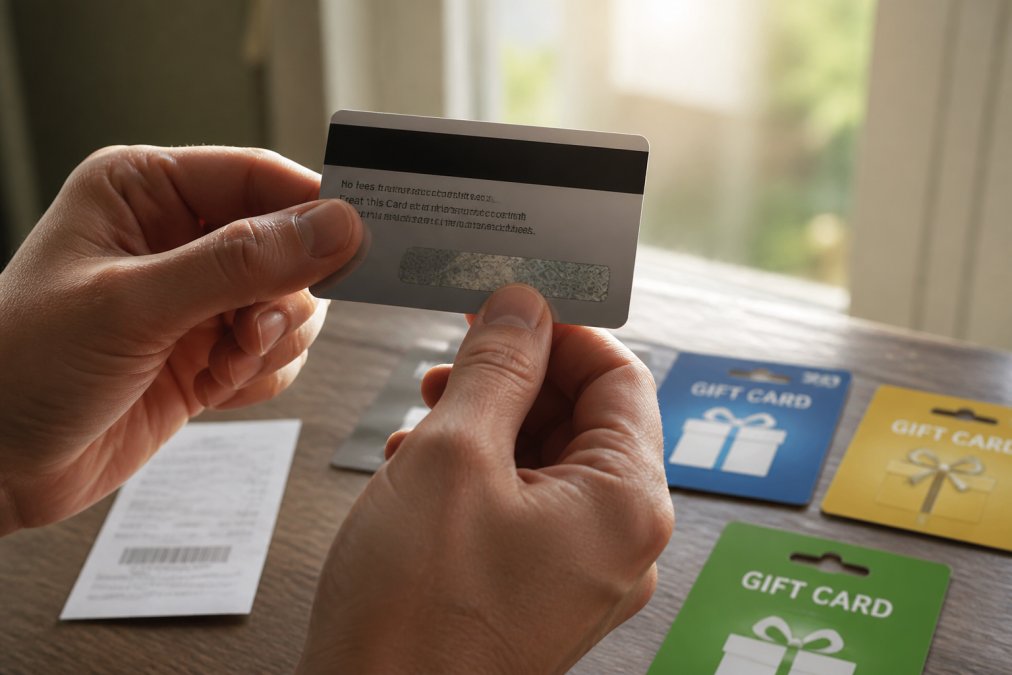
What a Clean Card Looks Like vs. a Tampered One
Most guides tell you to "check for tampering" without showing you what that means. Here is the side-by-side comparison that actually matters:
| Feature | Clean Card | Tampered Card |
|---|---|---|
| Scratch-off PIN panel | Flat, matte, silver coating fully intact | Lifted edge, dull or smudged coating, faint residue ring around the panel |
| Card number | Crisp, uniform embossing or print | Rubbed, faded, or partially scratched digits |
| Barcode | Sharp black bars, no overlay | A sticker placed over the original barcode, or a barcode that peels at the corner |
| Packaging seal | Smooth, factory-creased, no adhesive residue | Wrinkled edges, cloudy glue lines, or a resealed flap that does not lie flat |
| Card backing | Cardboard flush with the card | Card slightly bowed or the backing peeling away |
The Thirty-Second Shelf Check
Run this before you pay:
- Hold the card up to a light and look for a faint rectangle where a sticker may have been lifted and reapplied
- Run a fingernail along the edge of the scratch-off panel, a clean panel has no lip; a tampered one often does
- Confirm the barcode on the card matches the barcode printed on the packaging
- Check that the packaging has no added stickers covering the barcode or the activation strip
- Confirm the card number has not been scratched or rubbed
- Keep the activation receipt, which is your proof of purchase
If anything about the packaging feels off, hand it to a cashier and pick another card. Do not buy it "just to be safe", a drained card is far harder to resolve than a swapped one.
After You Buy
Activate the card, then check the balance within a few days and again right before you hand it over. If the balance is short or zero, contact the issuer immediately with your receipt, the sooner you flag it, the better the odds the issuer can trace the activation and freeze the remaining funds.
Step 4: Choose Secure Payment Methods for Online Shopping
Credit cards offer the strongest fraud protection of any common payment method, because federal law limits your liability for unauthorized charges. Choosing secure payment methods for online shopping is about matching each purchase to the protection it deserves.
Credit Cards vs. Debit Cards vs. Digital Wallets
| Method | Fraud Protection | Reversibility | Best For |
|---|---|---|---|
| Credit card | Strong, federally limited liability | Chargeback available | Most online purchases |
| Debit card | Tied to your own funds | Limited, slower recovery | Small, trusted purchases |
| Digital wallet | Tokenized card data | Follows the linked card | Everyday mobile checkout |
| Gift card | None | Effectively irreversible | Gifts only, never payment |
The FTC guidance on gift card scams is blunt on this point: gift cards are for gifts, not for payments. No legitimate business, government agency, or utility accepts gift cards as an emergency payment method. Anyone who insists on one is running a scam.
Step 5: Protect Your Gift Card Information After Purchase
Treat a gift card like cash the moment it is activated, because that is exactly what it is. Store the card and its receipt separately, and photograph the front, back, and receipt so you have a record if the physical card is lost.
A few habits close most of the gaps:
- Register the card with the retailer if the issuer allows it, so you can track activity.
- Check the balance within a few days of purchase and again before you hand it over.
- Avoid posting photos of the card, especially the PIN, on social media.
- Redeem the balance promptly rather than letting it sit for months.
Step 6: How to Report Online Shopping Fraud and Recover Funds
Speed matters more than anything else when you need to know how to report online shopping fraud. The faster you act, the better your odds of recovering funds or at least limiting the damage. Most guides stop at "contact the issuer." The workflow below goes further, including the digital-card recovery steps that text-heavy results leave out.
If a Physical Gift Card Was Drained
- Contact the card issuer or bank immediately and dispute the charge. Report it as unauthorized.
- File a report with the FTC at ReportFraud.ftc.gov, which feeds complaints into a national database used by law enforcement.
- Notify the gift card issuer with your receipt and card number so they can flag the card and trace the activation.
- Report identity theft at IdentityTheft.gov if your personal or financial information was exposed.
- File a police report if the loss is significant, since some banks require one for larger disputes.
- Change passwords on any account you used to make the purchase.
Recovery Workflow for a Drained Digital Card
Digital cards are the hardest to recover because there is no physical evidence and the funds move in seconds. If a card you received by email shows a zero balance, work through these steps in order:
- Preserve the original email. Do not delete the confirmation message or the sender's address. It establishes when the card was sent and to whom.
- Screenshot the zero-balance check with the date and time visible. This is your proof the card was already empty when you tried to use it.
- Contact the sender first. Ask for the original purchase confirmation, order number, and the email address the card was delivered to. If the sender's account was compromised, the card may have been intercepted before it ever reached you.
- Contact the issuer's gift card support line, not general customer service. Give them the card number, the purchase date, the sender's email, and your screenshots. Ask them to open a fraud investigation and to check the redemption timestamp against the delivery timestamp.
- Check your digital wallet history. If the card was added to a wallet, review the transaction log for the redemption time and any linked device. A redemption that happened before you received the card is strong evidence of interception.
- File the FTC report and, if the amount is significant, a police report. Include the issuer's case number so the reports cross-reference.
What to Expect
Recovery is not guaranteed. Issuers often treat a drained card as a completed transaction unless you can show the redemption happened before delivery or without your involvement. That is why the timestamp and the original email matter more than anything else you can collect. Keep every receipt, email, and screenshot, consumer protection agencies and banks both rely on documentation, and a clear paper trail shortens the process.
Step 7: Safe Secondary Market Alternatives for Gift Cards
Resale marketplaces sell discounted gift cards, and some buyers save real money there, but the secondary market carries genuine risk. Cards bought from third-party auction sites or informal sellers can be drained, counterfeit, or already reported stolen.
- Buy only from established platforms that offer a balance guarantee and a refund window.
- Verify the balance immediately after purchase, before the guarantee expires.
- Prefer cards with a clear purchase history and a seller rating you can check.
- Avoid unsolicited offers from individuals on social media or classified sites.
Frequently Asked Questions
What are the latest online gift scams to watch for in 2026?
Gift card draining remains the top threat, where scammers steal the PIN before you buy. Other common tactics include fake online stores that mimic real retailers, unsolicited offers on social media, and phishing emails pretending to be from gift card brands. Scammers also use social engineering to convince you to pay with gift cards for taxes, bills, or emergencies. Never share gift card numbers with anyone who contacts you first, and always buy from reputable retailers directly.
How can I verify if an online gift store is legitimate?
Check the URL for misspellings or unusual domains. Look for a working phone number and physical address. Search the store name plus 'scam' or 'reviews' to see what others say. Test the customer service email before buying. If the site lacks an About page, privacy policy, or secure checkout (look for HTTPS), treat it as suspicious and shop elsewhere.
What should I do if I suspect I have been scammed while buying a gift?
Act fast. If you paid by credit card, call your issuer and request a chargeback. For debit cards, contact your bank immediately. Report the scam to the FTC at ReportFraud.ftc.gov and your state attorney general. If you used a gift card, report it to the card issuer and check your balance. Keep all transaction records, emails, and screenshots. Change passwords if you shared account information. The sooner you report, the better your chance of recovering stolen funds.
Is it safe to buy gifts from social media advertisements?
Not always. Scammers often run ads on social platforms with stolen product photos and unrealistically low prices. Before buying, reverse-image search the product photos to see if they appear on other sites. Check the advertiser's page for recent complaints. Look for a verified business profile and real customer reviews. If the ad pressures you with countdown timers or limited stock, that is a red flag. Stick to reputable retailers or brands you can verify independently.


